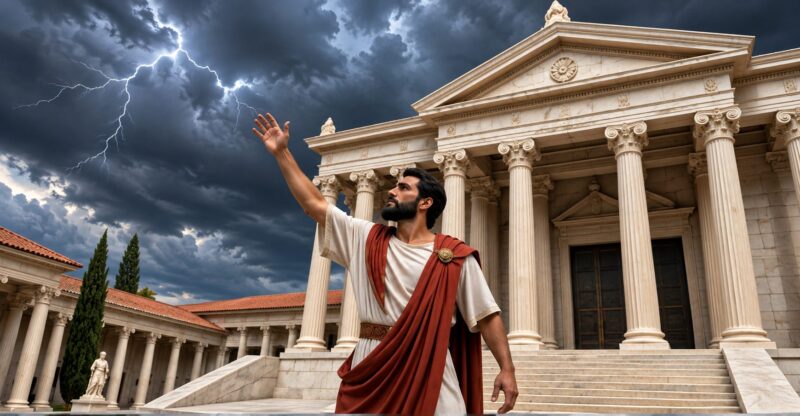
Long before telescopes revealed its swirling clouds and enormous storms, Jupiter was already connected to power, thunder, and the heavens through Roman mythology. The Romans named the bright planet after Jupiter, their supreme god, never knowing how fitting that name would become. Centuries later, science revealed that Jupiter is the largest planet in the Solar System, a massive gas giant surrounded by many moons and dominated by powerful storms such as the Great Red Spot. From Galileo’s discovery of its four famous moons to modern spacecraft exploring its atmosphere and magnetic field, Jupiter has remained one of the most fascinating worlds beyond Earth. Its story connects ancient mythology with modern astronomy, showing how human understanding of the sky has changed across thousands of years.
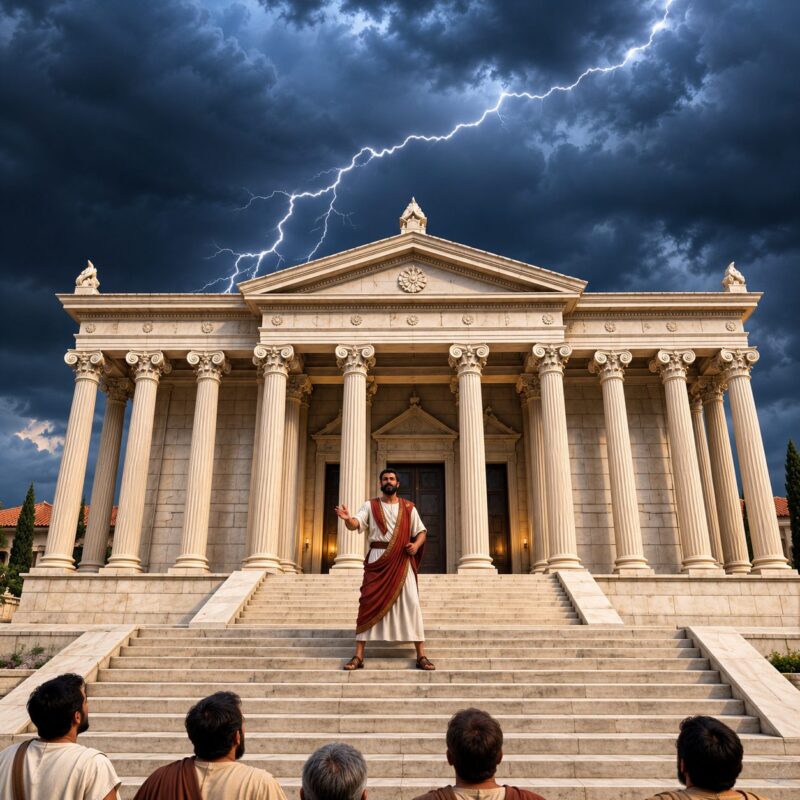
When the ancient Romans looked up at the night sky, they saw a bright point that seemed to stand out from the others. They had no telescopes, so they could not see its enormous clouds, powerful storms, or the many moons orbiting around it. But they knew one thing: this celestial object did not look like an ordinary star.
In Roman mythology, Jupiter was the supreme god. He was considered the ruler of the sky, thunder, and lightning, the king of the gods, and one of the most important protectors of the Roman state. He was often portrayed as a strong, bearded man holding a lightning bolt. When thunder echoed across the sky or lightning flashed brightly, people associated it with Jupiter’s power.
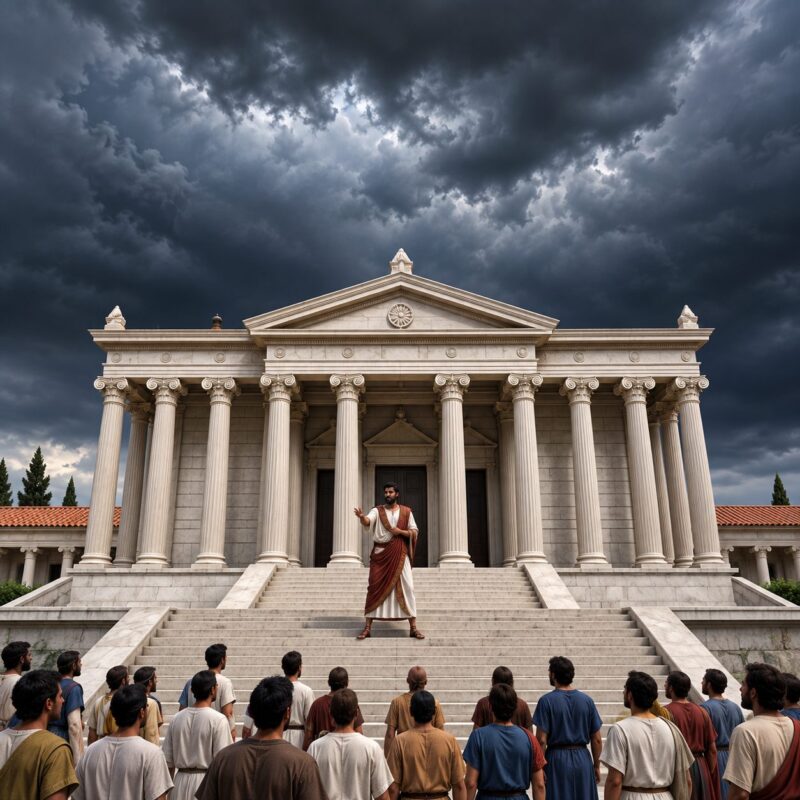
In ancient Rome, his name carried enormous importance. Temples were built in his honor, religious ceremonies were held for him, and major state events were often accompanied by prayers to Jupiter. One of his most famous temples stood on the Capitoline Hill, where Jupiter became one of the great symbols of Rome’s strength.
But there is one important thing to understand.
The god Jupiter did not literally “turn into” a planet. Instead, the enormous planet already visible in the sky was given the name of Rome’s chief god.
And that choice was not accidental.
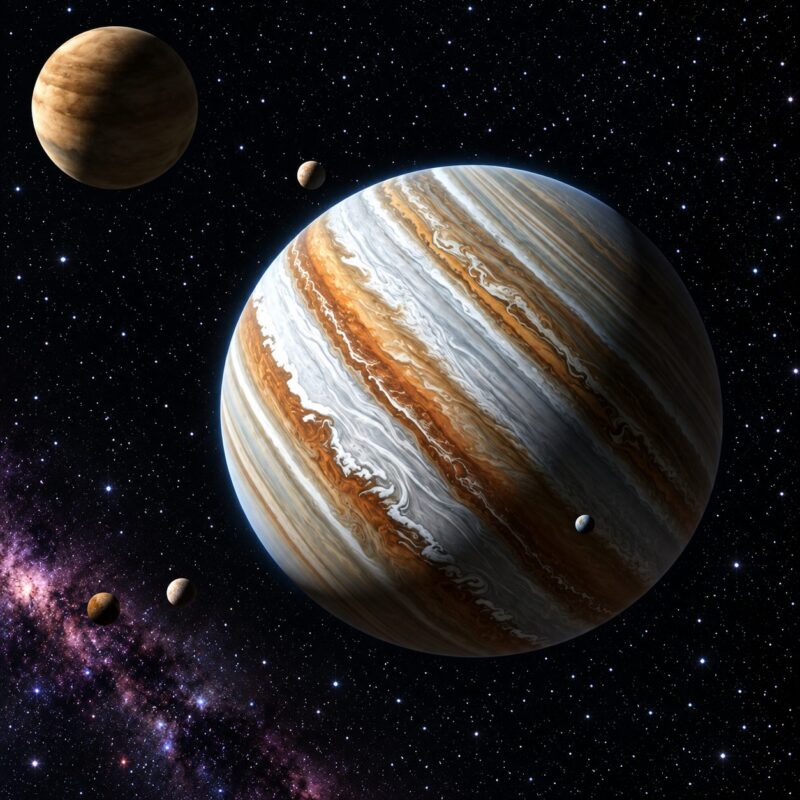
Jupiter is the largest planet in the Solar System. Its volume is so enormous that more than a thousand Earths could fit inside it. If Jupiter were shown as a giant sphere, our planet would look tiny beside it.
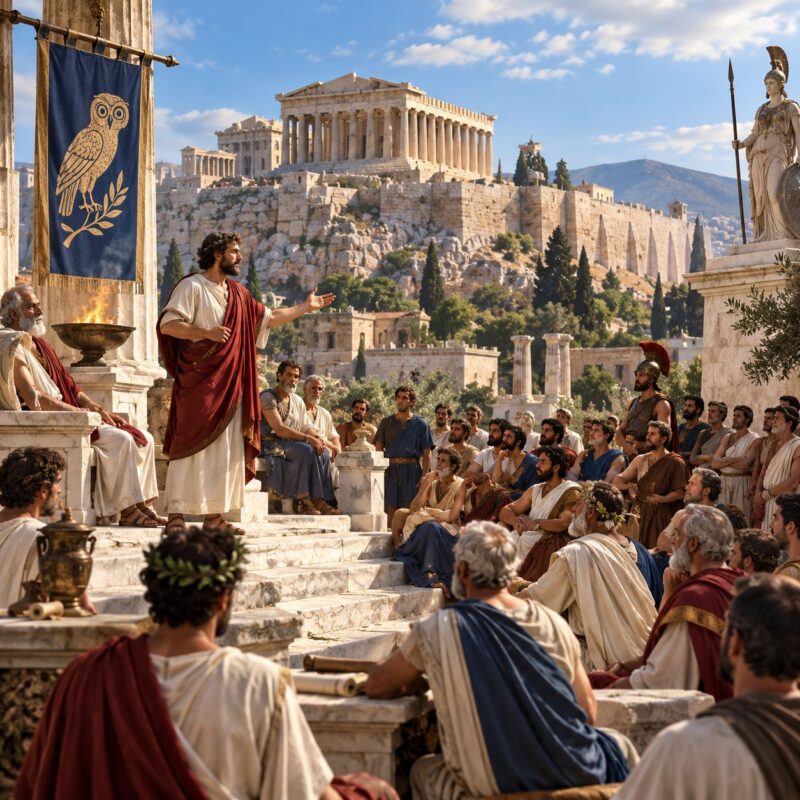
Its great size and brightness in the night sky made it a symbolic celestial body. For the Romans, it made sense to give the name of their most powerful god to one of the most impressive objects they could see in the heavens.
Centuries later, as astronomy developed, people began discovering what was really hidden behind that bright point in the sky.
In 1610, Galileo Galilei pointed a telescope toward Jupiter and noticed four bright objects moving around it. These were Io, Europa, Ganymede, and Callisto—the four moons now known as the Galilean moons.
This discovery was historically important.
At the time, many people still believed that all celestial bodies revolved around Earth. But the moons clearly orbiting Jupiter showed that the universe was more complicated than that.
Over time, astronomers discovered more and more remarkable facts about Jupiter.
They learned that Jupiter is not a rocky planet like Earth. It is made mostly of hydrogen and helium and belongs to a class of planets known as gas giants.
Its atmosphere is enormous and extremely active. Different layers of clouds move at different speeds, forming the famous white, yellowish, brown, and orange bands visible across the planet.
One of Jupiter’s most famous features is the Great Red Spot.
It is a gigantic storm that has existed for a very long time. At various points in history, it has been large enough for the entire Earth to fit inside it. The storm has been spinning through Jupiter’s atmosphere for centuries.
And here there is an interesting coincidence.
The ancient Romans associated Jupiter with the sky, thunder, storms, and immense power. The real planet Jupiter also turned out to be a world filled with enormous storms, powerful atmospheric activity, and extraordinary energy.
Of course, the Romans could not have known that.
They simply named a bright planet after their supreme god. But centuries later, science revealed that the planet itself was truly extraordinary.
Jupiter also has an extremely powerful magnetic field. It is far stronger than Earth’s and creates an enormous magnetosphere around the planet.
Jupiter is surrounded by many moons, and several of them are especially interesting to scientists.
Europa, for example, is covered in ice. Scientists believe that beneath its thick frozen surface there may be a vast ocean of liquid water. Because of this, Europa is considered one of the most interesting places in the Solar System in the search for environments where life might possibly exist.
Ganymede is also remarkable.
It is the largest moon in the Solar System and is even bigger than the planet Mercury.
So, long ago, people saw only a bright point in the night sky and connected it with the king of their gods. Today, we know that behind that point lies a massive, complex, and mysterious world.
Modern spacecraft have traveled close to Jupiter, photographed its clouds, studied its magnetic field, and measured the composition of its atmosphere. Every new observation shows that even after centuries of study, Jupiter still holds many mysteries.
The story of Jupiter brings together two very different worlds: mythology and science.
In the ancient world, Jupiter was the ruler of the heavens, the god associated with thunder and lightning.
In the modern world, Jupiter is a gigantic gas planet filled with storms, moons, powerful radiation, and an immense magnetic field.
The god remained in mythology.
But his name continued its journey into space.
Today, when we look at Jupiter through a telescope or see images captured by spacecraft, we are looking at both a scientific wonder and a name that carries thousands of years of human history.
Perhaps that is one reason Jupiter continues to fascinate us.
It reminds us of how people have tried to understand the sky across different ages—first through stories, myths, and gods, and later through telescopes, mathematics, and space exploration.
Jupiter is no longer simply a bright point in the night sky.
It is a giant world that humanity is still discovering.