
Body language can reveal moments of stress, discomfort, or hesitation, but no single gesture can prove that someone is lying. Certain changes, however, may deserve closer attention—such as suddenly touching the face or neck, becoming unusually restless, freezing into an overly controlled posture, or making gestures that seem inconsistent with spoken words. The key is not to judge a person from one movement, but to notice how their behavior changes during specific questions. A normally calm person who suddenly becomes tense may simply feel uncomfortable, not deceptive. Understanding body language requires context, patience, and comparison with the person’s usual behavior. These four signs are clues to observe carefully, not automatic proof of dishonesty.
Most people think they can immediately recognize a liar by watching their eyes or facial expressions. In reality, it is not that simple. A person may avoid eye contact because they are shy, touch their face because they are nervous, or move their hands constantly simply out of habit.
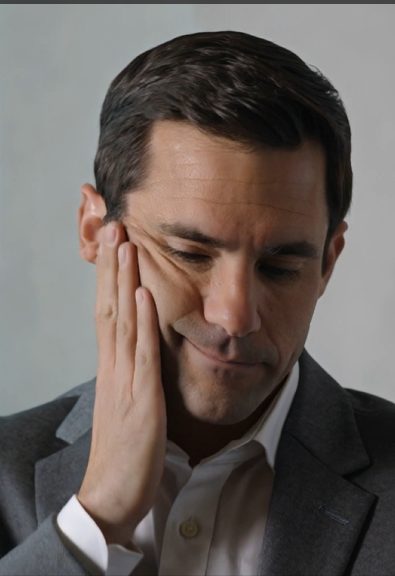
However, when someone’s normal behavior suddenly changes during a specific question, that change can become an interesting signal.
Imagine an ordinary conversation.
A man is sitting calmly at a table. Another person is asking him questions. At first, the conversation is simple. They talk about neutral topics such as work, the day, and everyday details.
The man’s movements are natural. His hands are relaxed, he occasionally smiles, and he answers the questions without difficulty.
Then one question seems to change the atmosphere.
“Were you there yesterday evening?”
The man pauses for a moment.
“No.”
But as he answers, his hand moves toward his neck. He lightly rubs the skin with his fingers and then touches his face.
This is the first gesture worth noticing: touching the face or neck.
People often make movements like these when they feel nervous or uncomfortable. It does not automatically mean they are lying. But if the gesture appears only when a particular subject is mentioned, it may suggest that the topic is sensitive for them.

The questions continue.
The man answers again, but now his hands begin behaving differently. He starts playing with his fingers, adjusts his sleeve, and then lets it go again. A few seconds later, he changes the position of his legs and begins tapping his fingers on the table.
This is the second possible sign: more restless movement than usual.
Again, the important thing is to compare this behavior with how the person acted earlier. If he was restless throughout the entire conversation, then the hand movements may mean very little.
But if he was calm at first and suddenly became much more fidgety after a difficult question, he may simply be experiencing tension.
This is where people often make a mistake.
They notice one gesture and immediately decide, “He is lying.”
In reality, the same behavior can be caused by stress, embarrassment, fear, or discomfort.
Then comes an even more direct question.
“Are you sure you are not hiding anything?”
This time, the opposite happens.

The man, who was moving constantly just moments earlier, suddenly becomes completely still. His hands remain in the same position, his shoulders become tense, and his facial expression appears unusually controlled.
This is the third interesting change: unusual stillness.
Sometimes people become so worried about revealing nervousness through body language that they try not to move at all.
They may think, “If I stay perfectly calm, nobody will notice anything.”
But that overly controlled stillness itself can attract attention.
Once again, it is not proof of deception. Some people naturally freeze under pressure. However, if this behavior is a sudden change from how the person was acting before, it may be worth noticing.
Then comes the final question.
“Did you take the document?”
The man answers quickly.
“No, I definitely didn’t take it.”
But at the same moment, his head makes a very slight movement to the side.
His words say “no,” while the small body movement seems not to fully match what he is saying.
This is the fourth possible signal: a mismatch between spoken words and body gestures.
A person’s face, hands, voice, and movements do not always react at exactly the same speed. When someone is carefully controlling their words, small physical movements may sometimes appear inconsistent with what they are saying.
But there is an important limitation here as well.
A slight head movement, looking away, or a facial expression does not mean that someone is definitely lying. These behaviors may simply be reasons to listen more carefully or ask another question.
For this reason, people who study behavior usually recommend looking for patterns rather than relying on one single gesture.
Imagine two situations.
In the first situation, a person touches their face throughout the entire conversation. That may simply be a habit.
In the second situation, the person sits calmly for half an hour, but immediately after one specific question, they touch their neck, start moving their hands, and then suddenly become completely still.
The second situation is more interesting because the behavioral change appears connected to a specific topic.
That is one of the most important principles: first understand a person’s normal behavior, and then notice what changes.

There are also many reasons why an innocent person may appear nervous.
They may be afraid that nobody will believe them. They may have a bad memory connected to the subject. They may simply dislike conversations that feel like interrogations.
That is why body language is better treated as a clue, not as a verdict.
If someone touches their face, begins fidgeting, suddenly becomes stiff, or makes gestures that do not seem to match their words, it may suggest that something is making them uncomfortable.
But to understand what is really happening, you need to consider the whole situation: what the person says, the surrounding facts, the context, and how they normally behave.
Sometimes the most important signal is not what a person does, but what they suddenly begin doing differently.