Long before cities, farms, or written language, early humans survived through cooperation, observation, and shared knowledge. Their daily lives were shaped by hunting, gathering plants, making stone tools, finding water, protecting children, and keeping fire alive. Success depended less on individual strength and more on the ability to work together as a group. Hunters followed tracks and animal behavior, while others prepared food, repaired tools, collected firewood, and taught younger members by example. Every skill mattered, because one unsuccessful day could make survival more difficult. Their world was demanding, but these small communities developed habits that would eventually shape human history: teamwork, learning, storytelling, problem-solving, and the ability to pass knowledge from one generation to the next.
A Day in the Life of Early Humans: How They Hunted, Found Food, and Survived Together
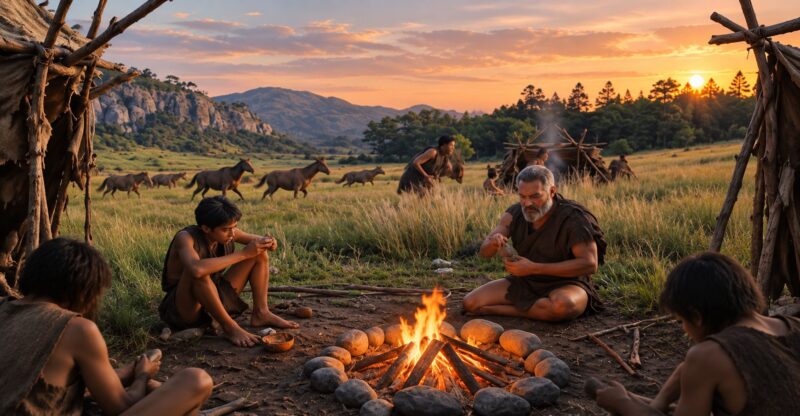
The sun had not fully risen yet, but the small settlement was already awake. Thin smoke rose from the fire, while the moisture of the night still covered the stones and grass. Everyone in the small group had a task. Some added wood to the fire, others cleaned roots and berries gathered the previous day, while the children sat nearby watching the adults and trying to copy their movements.
Life in such communities was not easy. Every day depended on the weather, the animals, access to water, and cooperation between people. They could not simply wait for food to appear. Everyone contributed in some way to the survival of the group.
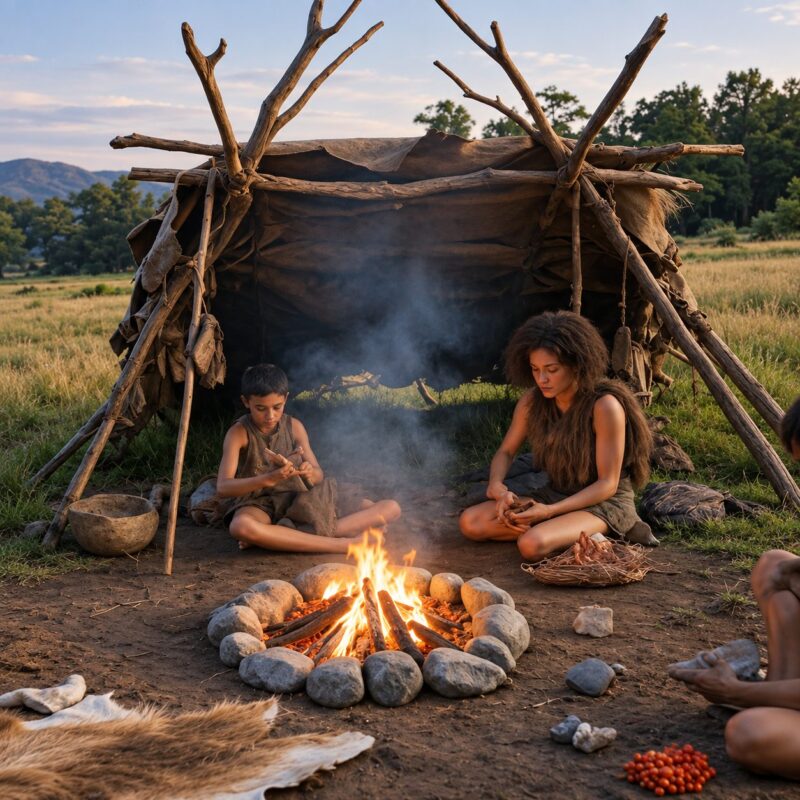
That morning, preparations for a hunt were underway.
Several men and two young women gathered near the stone tools. They checked their wooden spears, sharpened the stone points, and secured them with leather straps. Everything was simple, but important. If a tool was poorly made, the hunt could fail.
One of the oldest hunters silently raised his hand.
Everyone stopped.
He pointed to tracks left on the ground.
A group of large animals had passed through the area not long before.
The hunters began moving.
They did not run forward without thinking. Instead, they moved carefully. They listened to birds, looked at broken branches, and studied marks left in the damp soil.
To them, nature was not simply a beautiful landscape.
It was information.
An animal track, crushed grass, fresh droppings, or footprints in the mud could reveal which direction an animal had gone, how recently it had passed, and whether it was alone or part of a larger group.
A few hours later, they reached the top of a low hill.
In the distance, a herd of animals was moving across the open grassland.
The hunters immediately lowered themselves into the tall grass.
One of them signaled with his hand.
The group split up.
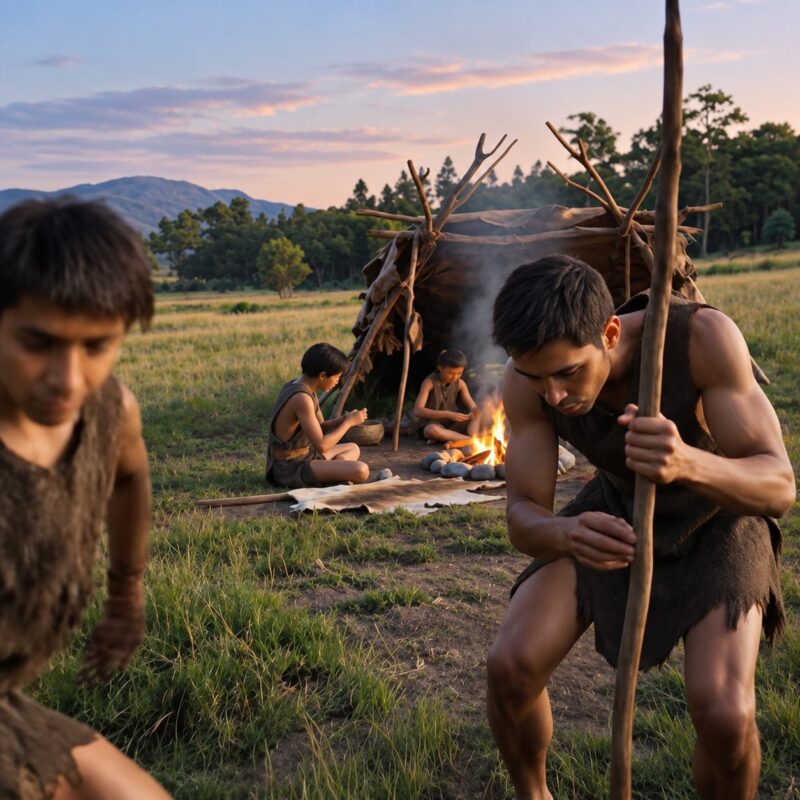
Some moved around the animals from the right, while others remained ahead. Their goal was simple: separate one animal from the herd and guide it toward an area where approaching it would be easier.
This was not only about strength.
Hunting required patience, teamwork, and a deep understanding of animal behavior.
At one point, one animal separated from the others.
The hunters moved more quickly.
They raised their spears and began guiding the animal toward a narrower space.
Such hunts were dangerous. One wrong move could not only ruin the entire day, but also injure one of the hunters.
That was why they worked together and avoided acting recklessly on their own.
Meanwhile, life continued back at the settlement.
The women and men who had not joined the hunt worked on different tasks.
One person was making a new tool from stone. He struck one rock against another, breaking off small pieces until a sharp edge appeared.
Another person cleaned and prepared an animal hide.
Later, that hide could become clothing, a blanket, or part of a temporary shelter.
Others went to the river to collect water.
Several children gathered dry branches.
Most of what they learned came not through formal lessons, but through observation.
A young boy sat watching an older woman clean a root with a stone tool. A few minutes later, he picked up a small stone and tried to do the same thing.
The older woman did not stop him.
She simply showed him how to hold his hand more safely.
That was how knowledge was passed on.
From one generation to the next.
Without books.
Without schools.
Simply by watching, copying, and remembering.
By midday, the gatherers returned.
They had brought berries, edible roots, some nuts, and plants that the group knew were safe to eat.
Early human diets did not depend only on hunting.
For many groups, plant foods, fruits, roots, and other gathered resources also played an important role.
When the hunters returned, the whole settlement became active.
Some of them were exhausted, but the hunt had been successful.
The food was divided.
Some of it was prepared immediately.
Another portion was processed so it could be kept for later.
People understood that the next day’s hunt might not succeed.
Stones were heated near the fire.
Meat was placed close to the flames.
Smoke spread through the settlement.
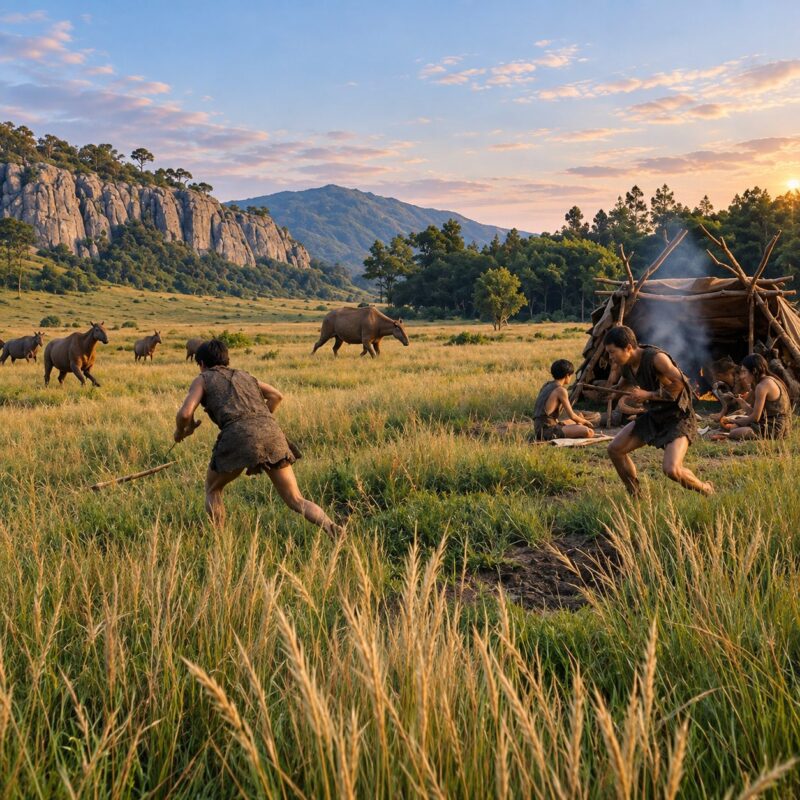
The children came closer, but adults kept them at a safe distance from the fire.
Another group began repairing damaged spears.
Even after a successful hunt, the work was not finished.
Tools had to be repaired.
Leather bindings had to be replaced.
Broken wooden shafts had to be fixed.
As evening approached, everything began to slow down.
The sun moved lower in the sky.
The air became cooler.
People gathered around the fire.
The food was shared.
No one had a separate table.
They ate together.
They worked together.
And they protected one another together.
One of the hunters began using his hands to show how the animal had first turned left and then suddenly changed direction.
The children watched carefully.
One adult laughed.
Another corrected the storyteller with a few gestures, as if saying that the event had happened a little differently.
Such stories were not only for entertainment.
They were also a form of teaching.
Children learned how to follow animals, recognize danger, find water, and avoid mistakes.
Night fell.
The forest around the settlement became dark.
The fire became the brightest point in the area.
People sat close together.
The fire did more than provide warmth.
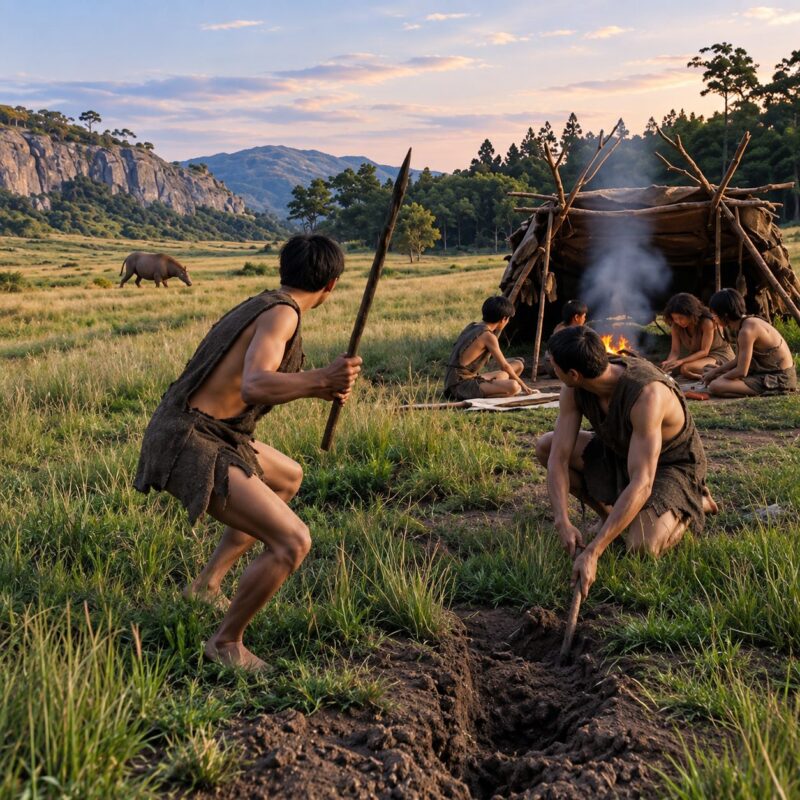
It also helped keep some animals away, cook food, and light the darkness.
But their greatest strength was not even the fire.
Their greatest strength was the group itself.
A person living alone would have had great difficulty surviving in that world.
But together, people could hunt, protect children, pass on knowledge, gather food, and help one another when danger appeared.
It was in the everyday lives of small groups like these that many of the skills that later shaped human history gradually developed.
Tools.
Cooperation.
Fire.
Learning.
Memory.
And most importantly, the ability to live and work together.
The life of early humans was a daily struggle against the challenges of nature, but it was not only a story of survival.
It was also the story of people learning from one another and becoming stronger together.