The first sign was so easy to dismiss that everyone did. A faint pink shadow bloomed on the baby’s cheek like a memory trying to form, the kind that looks more like a bruise than a warning. It wasn’t there at birth, not really—only a suggestion, a whisper under the skin. In those first weeks, life was ruled by feeding schedules, sleepless nights, and the soft rise and fall of a tiny chest. No one expected that something so ordinary could become a story that would stretch across years ⏳.
By the end of the first month, the mark had found its confidence. It announced itself openly, a brightening red that seemed almost cheerful, as if color alone could promise harmlessness. The doctors used calm words and careful explanations. They spoke of how these things appear, how nearly all of them reveal themselves early, how time is the true author of their behavior. There was comfort in statistics, in percentages that suggested predictability 📊.
Then came the weeks when growth felt like urgency. Between one breath and the next, it seemed larger, fuller, alive with its own intent. At night, when the house was quiet, the mark looked different under lamplight, its surface subtly lobulated, like something thinking its way outward. The phrase “strawberry mark” sounded almost cruelly gentle for something that could change so fast 🍓.

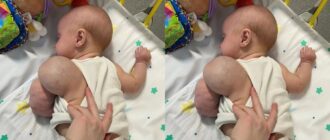
The baby didn’t know any of this, of course. She laughed, she learned the miracle of her own hands, she cried with the absolute honesty only infants possess. The hemangioma grew anyway. It followed its own calendar, racing through an early phase that no lullaby could slow. By three months, it seemed to have reached most of what it would ever be, as if it had sprinted through childhood before the rest of her body even learned to crawl 👶.
There were days when hope came easily. The doctors explained the pattern: rapid growth, then patience, then the long unwinding. They described involution as if it were a kind of grace, a slow retreat that could take years but usually ended in quiet resolution. Small ones fade with barely a trace, they said. Larger ones might leave a memory behind—a scar, a change in texture—but even that was only skin-deep. Words like “usually” and “often” floated in the air, light but heavy all the same 🌫️.

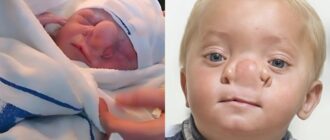
As months passed, the mark deepened in character. Sometimes it looked superficial and bright, other times shadowed with blue, hinting at depth beneath the surface. It seemed to choose its mood by the hour. When she cried, it flushed darker; when she slept, it softened, as if resting too. It was classified, labeled, understood—superficial, deep, mixed—but none of those words captured how it felt to watch something both fragile and relentless share a face with a growing child 🧠.
The slow phase arrived quietly. Growth no longer raced; it lingered. Time stretched. The family learned the art of waiting, measuring progress not in disappearance but in steadiness. Photos were taken from the same angle, the same light, searching for proof that the story was turning toward its ending. Sometimes it was. Sometimes it wasn’t 📷.
Years slipped by, and the involution began so subtly that no one could say exactly when. The red softened, the fullness eased, and the once-urgent presence began to recede. It didn’t vanish dramatically. There was no single morning where it was simply gone. Instead, it loosened its hold day by day, like a tide that forgets how far it once reached 🌊.

By the time she was older, the hemangioma had become a pale echo of itself. Where it once dominated, there was now a faint change in texture, a reminder more than a mark. Friends didn’t notice unless it was pointed out. Strangers never did. The doctors smiled in that quiet way that suggests a lesson completed 📖.
But the unexpected ending wasn’t written on her skin at all.
One afternoon, much later, she stood in front of a mirror and traced the place where the hemangioma had been. She listened as her parent told the story—how it appeared, how it grew, how it slowly let go. She didn’t look frightened. She looked curious. Then she smiled, not at her reflection, but at the idea that something once so powerful had shared her beginning and then stepped aside.

“It grew with me,” she said simply. “And then it trusted me to grow without it.” 💫
In that moment, the hemangioma stopped being a tumor, a lesion, a clinical journey measured in months and percentages. It became a quiet teacher. It had shown that not everything that arrives suddenly intends to stay forever, and not everything that leaves does so completely. Some things come to mark time, to test patience, and to prove that even the most striking changes can become part of a larger, gentler story ❤️.
And that was the ending no one predicted—not disappearance, not perfection, but understanding.