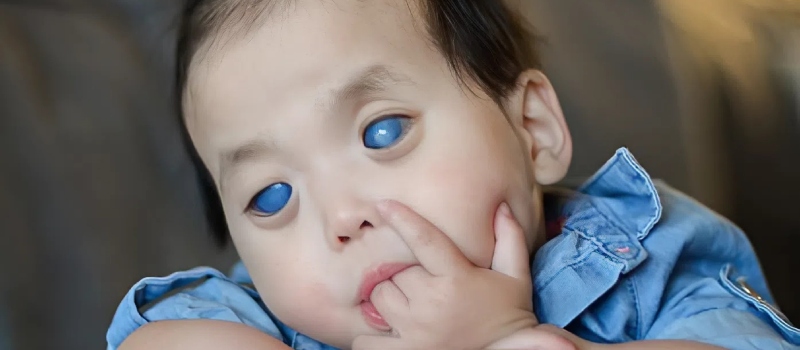
When Chris Austin first saw the photograph of a small girl in a Chinese orphanage, he was struck not by her tiny frame, nor by her fragile posture, but by her eyes. They shimmered like silver, almost unreal, holding a depth that seemed far beyond her years. The glow was mesmerizing, yet eerie, and he instinctively knew that this child carried a story no one had taken the time to listen to.
He called his wife, Eryn Austin, into the room, pointing silently to the photo. Eryn felt the same pull, a mixture of awe and tenderness, and whispered softly, “We have to meet her.” ❤️ Two years later, they brought her home. Her name was Primrose, and she was three years old, frail in body but possessing a presence that demanded attention.
Life at home was a slow, painstaking process. Primrose couldn’t sit upright, she struggled to hold her head steady, and even the simplest tasks, like lifting a spoon, felt impossible. Her parents had to teach her everything—how to respond to affection, how to move her limbs, even how to breathe in rhythm with the world around her. Most children would have been frustrated by the patience required, but Primrose, in her quiet way, absorbed every lesson. Outside their home, the world reacted differently.

Children screamed and ran away when they saw her eyes. “She’s a monster!” they shouted. Strangers would stare, whisper, and sometimes recoil in fear. Eryn would gather Primrose into her arms and murmur, “You are beautiful, my love. Never forget that,” shielding her from the harsh judgments of a world obsessed with normalcy. 🌼
Medical examinations revealed why life had been so difficult for Primrose. She had congenital glaucoma, a condition that had caused dangerously high pressure in her eyes from birth. One eye had begun to detach, the other had shrunk dramatically, and both were sources of excruciating pain. Further tests uncovered a rare 6p25 deletion syndrome, which explained her low muscle tone, learning difficulties, and hearing problems. Still, Chris and Eryn refused to see these diagnoses as limitations. Every small victory—Primrose sitting upright, holding a spoon, smiling—was a monumental achievement in a life that had started with so little care. 👁️
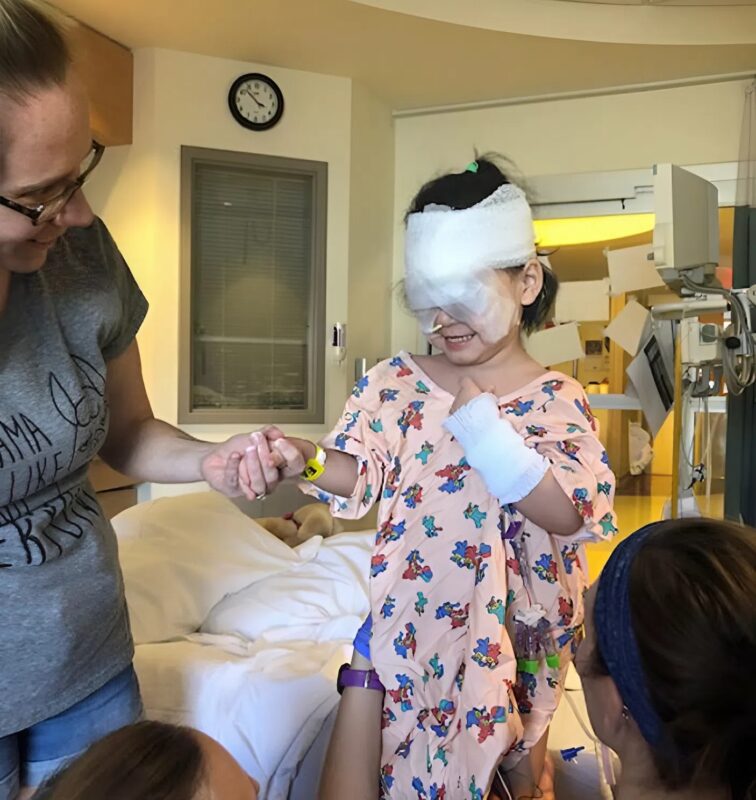
Then one August, when Primrose was five, her life changed dramatically. She woke up crying, but unlike ordinary tears, this was a pain that wracked her tiny body for hours on end. She refused to eat, sweated profusely, and cried sometimes for sixteen hours straight. Every movement seemed to magnify the agony inside her. The Austins were desperate. Syringes were used to keep her hydrated, and Chris spent sleepless nights holding her in a silent vigil as she shook with pain. For seventy-six days, the family endured what they later called “the 76 days of crisis,” searching for answers from doctors who tried every intervention possible. 💔
Finally, an MRI scan revealed the extent of the damage. One eye had suffered a retinal detachment, and the other had shrunk to almost half its original size. The optic tissue was irreparably damaged. There was only one solution left: complete removal of both eyes. The decision felt unimaginable. Eryn wept quietly as Chris held Primrose’s small hand, whispering assurances that they were doing this out of love. The surgery took several hours, and when it was over, doctors reassured the parents that it had been successful.

But the real miracle occurred two days later. Primrose, who had been barely able to lift herself from the bed during the past months, stood up for the first time. Her small legs trembled, but she walked toward Chris, who caught her with tears in his eyes. Eryn could hardly speak, unable to comprehend the sudden transformation. Over the following weeks, Primrose’s progress accelerated. She began eating normally again, sleeping through the night, and using her fingers to pinch small snacks—skills she had never managed before. Her laughter, once rare, filled the home with warmth and light. 🌈
As part of her recovery, doctors fitted her with prosthetic implants and planned for painted shells to recreate the appearance of eyes. Yet even before the cosmetic work was complete, something extraordinary began to emerge. Primrose seemed to sense light and warmth in her environment, turning toward windows when sunlight streamed in, smiling at the glow of lamps, and giggling when near warm surfaces. It wasn’t sight in the traditional sense, but rather a new perception of the world, one that no one had predicted. Her brain appeared to have adapted, allowing her to feel the world through subtle cues that others overlooked. ☀️

One afternoon, Chris and Eryn watched her in the living room, sunlight spilling across the floor. Primrose lifted her face toward the warm beams and laughed—a sound full of joy and wonder. Chris turned to Eryn, his voice soft but certain. “For years, people thought her eyes made her different, even frightening. But now…” Eryn nodded, tears in her eyes, “…we see that those eyes were never what defined her. Her light comes from within.”

Primrose’s journey was far from ordinary. She would always experience the world differently, approaching life on her own terms. She might never see in the way most people do, might never speak clearly, but she had discovered something that no diagnosis could take from her: resilience, joy, and the ability to feel light in the darkness. In the end, the silver eyes that once drew attention for their strangeness had been replaced by something far greater—the unshakable radiance of her spirit. 💫

Her parents often reflected on their decision to adopt her, realizing that love, patience, and faith had created a miracle. And while the world had once labeled her a “monster,” now they watched a girl who was extraordinary in every sense—not for the way she looked, but for the light she carried and the courage she embodied every single day.