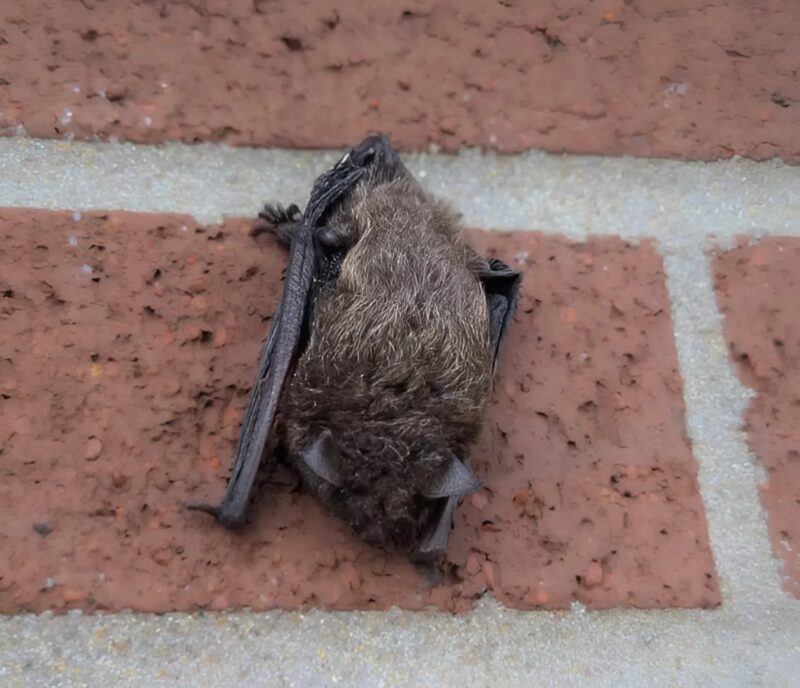
Eros had walked past the same red-brick office building in Kirkwood, Missouri dozens of times before, but that morning felt different. The air was cool, brushed with early autumn wind, and dry leaves scraped along the pavement in restless circles. As Eros approached the entrance, something unusual caught their eye — a small, dark “furry lump” clinging to the wall just beneath a second-floor window.
At first, Eros assumed it was debris stuck in the mortar. But the shape was too symmetrical, too deliberate. Curiosity tugged stronger than caution. Stepping closer, Eros felt their breath catch.
It wasn’t debris.
It was a tiny bat, no bigger than a thumb, pressing her delicate face into the brick as if trying to disappear into it. She didn’t move. Not even when the wind lifted her fragile wings slightly against the wall. 🦇
Concern prickled through Eros immediately. They hurried inside the office building and asked the employees if anyone had noticed the bat outside.
“Oh, that little thing?” one worker said. “She’s been there for days. We thought she was just… sleeping.”
“Three days?” Eros repeated, their voice tightening.
The workers exchanged uneasy glances. No one had wanted to interfere. No one had known what to do.
Eros stepped outside again, staring at the motionless creature. Something wasn’t right. And thankfully, Eros knew exactly who to call.
Their partner, Elspeth Furey, was a volunteer bat rehabilitator at the Wildlife Rescue Center — WRC. When Eros explained what they had found, Furey didn’t hesitate.
“That’s not normal,” she said firmly. “I’m coming.”
Within twenty minutes, Furey arrived with a transport kit in hand. She approached the bat slowly, speaking in soft murmurs as if the tiny animal could understand reassurance. Wearing thick gloves, she gently cupped the bat and eased her into a towel-lined container with small air holes.
The bat barely reacted. She was warm — but weak.
At WRC, the staff gathered around as Furey carefully lifted the tiny patient onto a padded surface. Under proper lighting, they could see the issue almost immediately. The bat’s delicate skin was irritated, and small mites clustered around her wings and neck.
“That would explain the lethargy,” one technician noted.
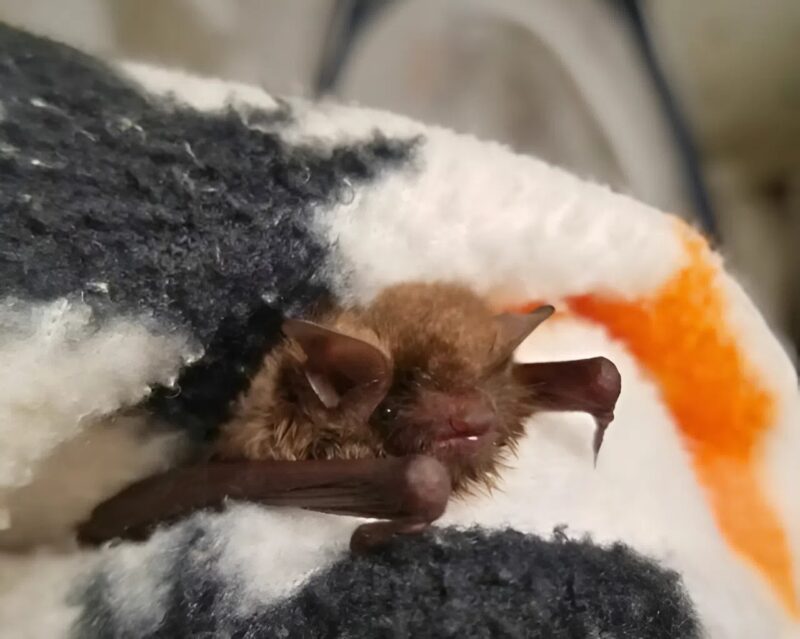
The team began treatment right away. Specialized medication was applied carefully, hydration was administered, and the bat was wrapped in soft fleece to preserve body heat. 🧣 Over the next 24 hours, they monitored her breathing and movement constantly.
Despite her frailty, there was something striking about her features. Her ears were slightly rounded in a particular way. Her fur carried a subtle sheen. Furey, intrigued, pulled out reference guides and began comparing measurements.
Hours later, she looked up from the textbook, eyes wide.
“I think she’s an Indiana bat.”
The room fell silent.
An endangered Indiana bat.
The staff leaned closer, examining her again with new reverence. Indiana bats were rarely seen up close, especially not in such vulnerable condition. Their populations had plummeted due to white-nose syndrome, habitat destruction, pesticide exposure, and shifting climates. 📉
“She was already special,” Furey whispered. “But this… this changes everything.”
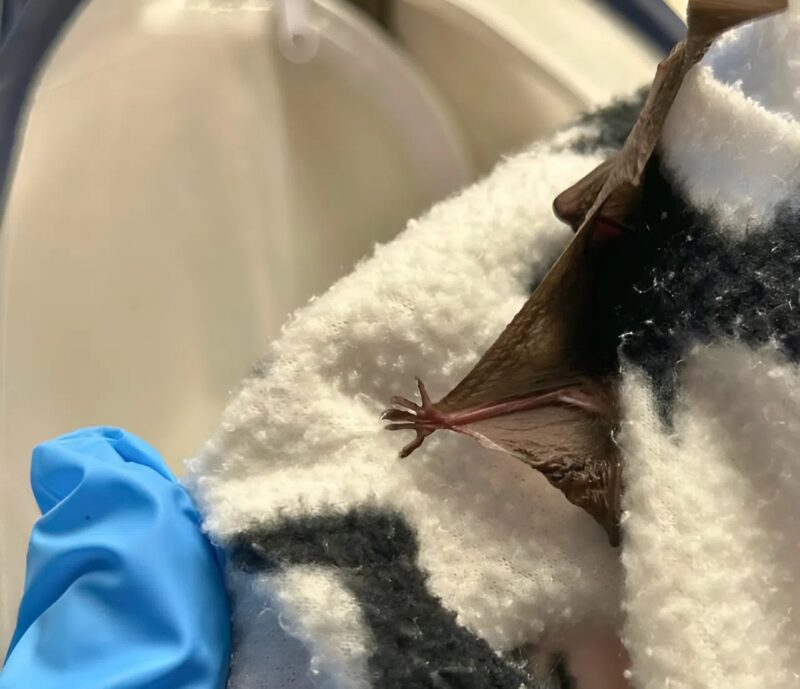
For three days, the little bat recovered steadily. She began lifting her head. Then flexing her wings. By the second night, she had climbed the side of her recovery enclosure, tiny toes gripping fabric with surprising strength. 🐾
Eros visited often, watching quietly from the corner of the room. It amazed them how such a small creature could command such care and attention.
On the third evening, the team prepared for release. The bat had regained weight, her mites were gone, and her energy had returned. The sun dipped low over the Missouri horizon, casting the sky in streaks of amber and violet. 🌅
They returned to the same general area where she had been found, choosing a safe wooded edge not far from the office building. Furey opened the container carefully.
For a moment, the bat hesitated.
Then she crawled onto Furey’s gloved hand, paused, and spread her wings wide.
She launched into the twilight sky in a smooth, silent arc.
Everyone exhaled in relief. 💚
But the story didn’t end there.
Two weeks later, Eros walked past the building again — this time at dusk. They slowed instinctively, glancing toward the brick wall.
Nothing.
They smiled, assuming the bat had moved on to safer roosting grounds.
Then something flickered above.
Eros looked up.
Three bats circled the building, swooping in coordinated loops. Their wings cut elegant shapes against the fading light. One broke from the pattern and glided closer to the brick wall — the exact spot where the tiny patient had once clung.
It landed.
And unlike before, it wasn’t alone.
Tucked just beneath the ledge were two even smaller bats, clinging together in a tight cluster. 🦇🦇
Eros stood frozen.

Indiana bats typically roost in trees — not buildings. Yet here she was, choosing this place deliberately. Choosing survival not just for herself, but for the next generation.
The rescued bat had been pregnant.
Back at WRC, Furey confirmed that during early examinations, they hadn’t detected signs. But Indiana bats often give birth to a single pup in late spring or early summer. The timing matched perfectly.
“She came back,” Eros said softly that evening, telling Furey what they had seen.
Furey felt a chill run down her spine.
Sometimes rehabilitated bats return briefly to familiar landmarks before fully migrating. But three bats circling together suggested something else.
The next few nights, Eros observed from a respectful distance. The mother bat would leave at dusk, forage, and return within the hour. The two tiny pups clung securely beneath the ledge, waiting.
Word quietly spread among local conservation groups. The presence of a small maternal roost — especially an endangered species — was extraordinary. Wildlife officials worked discreetly to ensure the building owners preserved the area undisturbed.
Weeks passed.
The pups grew stronger.
One evening, as a soft summer storm rolled in, thunder murmuring in the distance ⛈️, Eros watched as the two young bats attempted their first flight. They stumbled midair, corrected themselves, and found balance.
The mother circled patiently around them, guiding.
And then, as lightning briefly illuminated the sky, all three disappeared into the trees beyond the parking lot.
They never returned to the brick wall again.
But something had changed.
That winter, wildlife surveys in the region recorded a slight but measurable increase in Indiana bat activity in nearby wooded corridors. A small ripple in a struggling population.
It wasn’t dramatic. It wasn’t headline news.
But it mattered.
Sometimes conservation doesn’t look like grand gestures. Sometimes it looks like one person noticing a “furry lump” that others overlooked. It looks like a phone call. A pair of gloves. A towel-lined box. 🧤
It looks like three bats vanishing into a storm-lit sky — alive because someone chose to care.
And every time Eros passes that brick building now, they don’t just see bricks.
They see a beginning.