Kerie Ivory, 52, from Buckinghamshire, had always considered herself a healthy woman. She was a mother of two, full of life, and determined to enjoy every moment with her family. But over the years, a persistent cough and acid reflux began to chip away at her energy. Visits to her GP offered little reassurance—she was diagnosed with rhinitis, post-nasal drip, and even mild asthma. Yet Kerie knew something deeper was wrong. Every morning, she woke exhausted, barely able to get out of bed. 🛌
She remembers vividly the moment fatigue took over her life. “I had to choose between eating and having a shower,” she told herself one morning. By then, simple tasks felt insurmountable. Despite these warning signs, doctors insisted it was nothing serious. Kerie began to doubt herself but couldn’t shake the feeling that something else was happening in her body. When she was found to be anaemic, her intuition screamed that this was only the tip of the iceberg.
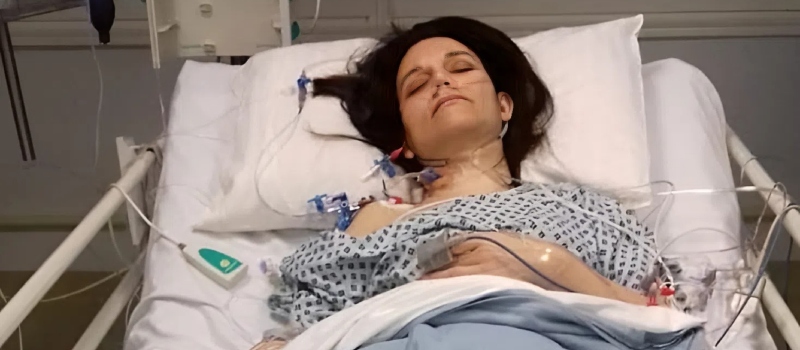
Fifteen months after her first symptoms, Kerie began experiencing severe digestive issues—bloating, wind, and stomach pain. Her belly would swell dramatically throughout the day, leaving her looking five months pregnant by evening. Frustrated and scared, she was referred for a colonoscopy, only to discover that the scope couldn’t pass through her intestines because of a tumour. Relief mixed with terror as she finally had an answer: she had neuroendocrine cancer, a disease she had unknowingly carried for almost four-and-a-half years. 😔
Surgery followed, grueling and exhausting. Doctors removed sections of her small and large intestines, her appendix, gallbladder, part of her liver, and several lymph nodes. A primary tumour in her ileocecal valve—the area separating the small and large intestine—had already spread to other lymph nodes. Even now, scans revealed additional lesions in her liver, spine, and ribs. Kerie’s life had been put on hold, as she waited for the tumours to grow large enough to qualify for treatment. ⏳

Living with a slow-growing cancer is a strange and isolating experience. “It’s hard living with a creeping disease,” Kerie admits. “I know it’s there, but there’s nothing we can do until it progresses. It’s devastating to feel powerless like this.” The irony was cruel—while other cancers received aggressive, immediate treatment, Kerie’s only option was patience. The disease forced her to quit her job in 2022 due to extreme fatigue, and everyday tasks became monumental. A simple trip to the spa required careful planning—she avoided swimming because washing her hair afterward would exhaust her completely. 🧖♀️
Her children struggled to understand the limitations imposed by her illness. Kerie could see the worry in their eyes, and sometimes guilt for what she could no longer do. “They know it’s never going away, and they realize that at times the cancer will grow and need treatment,” she explained. Even small joys, like going out with friends, came with a constant awareness of her energy limits. But Kerie remained determined to savor the moments she could, embracing life in whatever form it allowed. 💕

Despite the challenges, Kerie became an advocate for greater awareness of neuroendocrine cancer. Working with Neuroendocrine Cancer UK (NCUK), she shared her story to shed light on a disease that is often misdiagnosed as irritable bowel syndrome, asthma, or even menopause. NCUK reports that this cancer affects 6,000 people annually in England alone, with diagnosis often delayed by years. By the time many patients are correctly diagnosed, their disease has advanced, leaving fewer treatment options and heavier burdens on families.
One morning, as Kerie sat watching her children play in the garden, a thought struck her—what if her life didn’t have to revolve around waiting for the cancer to progress? That same week, a clinical trial for an innovative targeted therapy opened in London. With hope flickering in her chest, Kerie applied immediately. Weeks later, she received the news: she was accepted into the trial. 🌟
The treatment was unlike anything she had imagined. Instead of waiting, the therapy actively targeted her tumours, shrinking them before they could grow larger. Her energy levels began to improve, and she found herself able to enjoy simple pleasures again—walking her children to school, cooking meals without collapsing afterward, even laughing freely with friends. For the first time in years, life felt like it might reclaim its normal rhythm.

Kerie’s journey wasn’t over, and her cancer still required constant monitoring, but the waiting game that had dominated her existence was finally replaced with action. “It’s surreal,” she admitted, tears streaming down her face during one follow-up appointment. “For years, I was living with this invisible burden. Now, I feel like I’m finally fighting back, and that hope is priceless.” 🌈
Her story serves as a reminder that persistence, self-advocacy, and awareness can change the course of even the most insidious illnesses.

Kerie Ivory, once a woman forced to live with uncertainty, now stands as a symbol of resilience, proving that even the slowest-growing cancers can meet an unexpected, hopeful turn. Her life, once paused, now moves forward—one courageous step at a time. 💪
Through her journey, Kerie emphasizes that early recognition of subtle symptoms is crucial, and sharing stories can empower others to seek timely help. She dreams of the day when no one else will have to endure years of misdiagnosis and fear while the clock ticks away. And while neuroendocrine cancer remains a complex and challenging disease, Kerie Ivory’s story proves that even in darkness, hope can bloom unexpectedly. 🌸