When my seven-year-old son pulled a dusty toy car from an old wardrobe and immediately asked, “Mom, whose is this?” I froze. That little car had belonged to my brother, Andranik, whose name was almost never spoken in our home anymore. He had disappeared from our lives many years earlier, and since then our family had learned to live with silence instead of answers. But when I took the car from my son’s hands and wiped away years of dust, I noticed something I had never seen before. Hidden inside the toy was a tiny folded piece of paper. A few faded words were enough to make me realize that perhaps our past was not completely closed—and that the truth about my brother might still be found.
That day, I had simply decided to organize the old wardrobe.

It was one of the oldest rooms in our house, a small storage room where old photographs, clothes, boxes, children’s books, and little objects had collected over the years—things people keep not because they still need them, but because of the memories attached to them.
My son, Narek, was seven years old at the time and, naturally, was far more interested in adventure than cleaning. While I sat on the floor sorting through old albums and folders, he wandered around the room, opened drawers, looked through the upper shelves of the wardrobe, and asked questions about everything he found.
“Mom, what’s this?”
“An old blanket.”
“And whose books are these?”
“My schoolbooks.”
He would get bored with one thing and move on to another until he finally reached the tall wooden wardrobe that no one had opened in years. The doors were a little heavy, but he pulled with all his strength, and the old wood creaked.
“There’s so much dust in here!” he laughed.
I smiled too, but did not look over because I was still going through a bundle of old photographs.
A few seconds later, I heard him pulling some kind of box from the bottom shelf.
“Mom…”
There was ordinary curiosity in his voice, but his next words froze me.
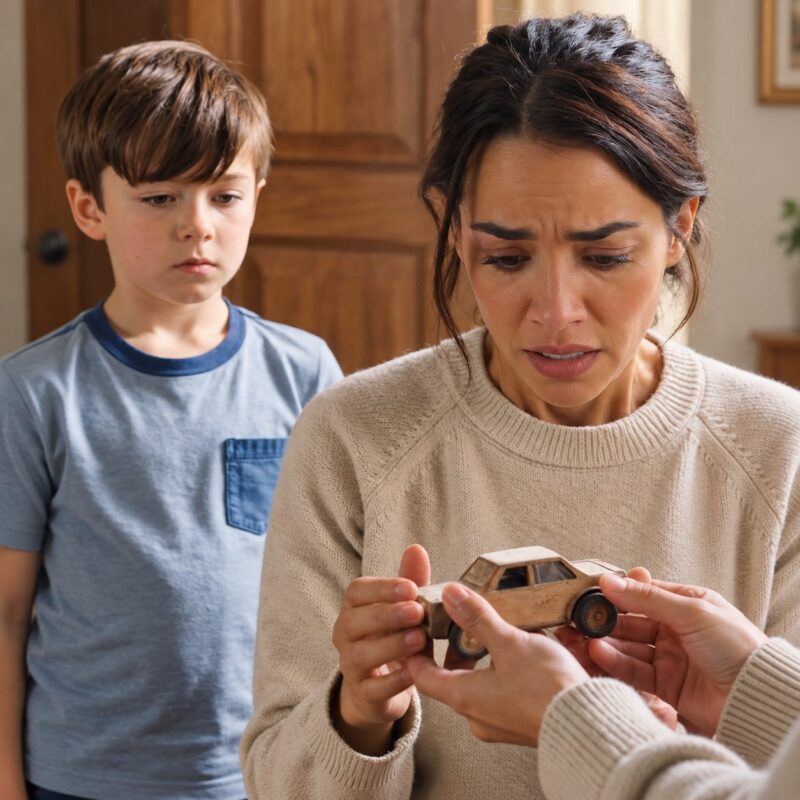
“Mom, whose is this?”
I looked up.
Narek was holding a small, worn toy car.
It was red, though much of the paint had faded. One wheel was bent, and there were old scratches along the metal side.
I recognized it immediately.
The room suddenly seemed silent.
The air felt heavier.
I slowly stood and walked toward my son.
“Give it to me,” I said quietly.
He looked at me in surprise, probably because it was the first time he had seen a toy change my expression so quickly.
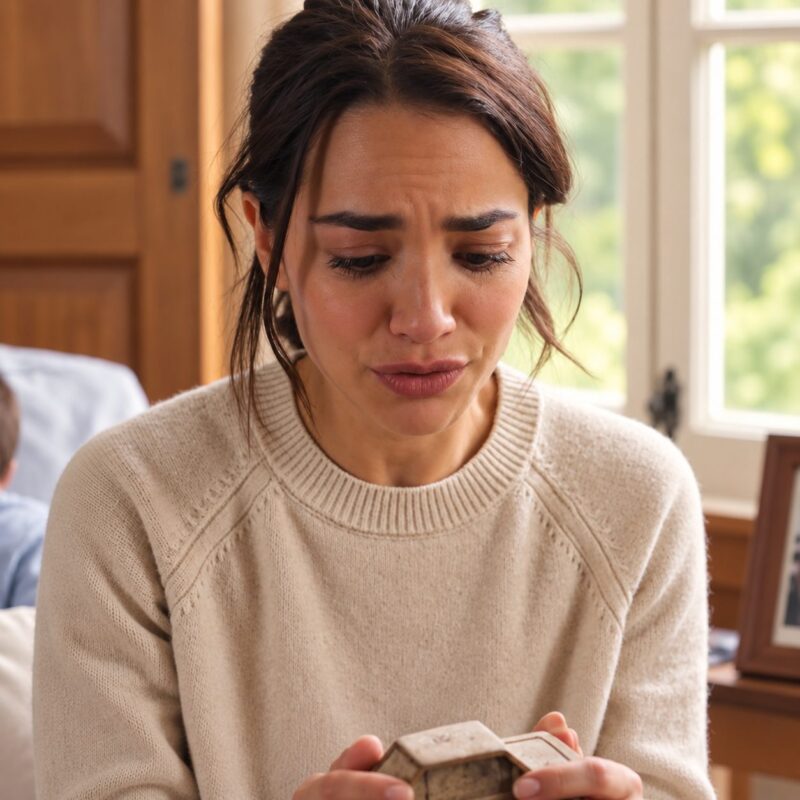
When I took the car, my hands began to tremble.
That car had belonged to my brother, Andranik.
He was three years older than me. When I was little, he carried that car everywhere. He would sit on the floor, imagine roads beneath it, and play for hours. I even remembered how, whenever I tried to take it, he would say, “That’s my favorite car. Be careful.”
Narek came closer.
“You know it?”
I answered in a barely audible voice.
“Yes… it belonged to my brother.”
“You had a brother?”
His question was simple, but for me it was heavy.
We almost never spoke about Andranik in our home. Not because we had forgotten him, but because the pain had never truly disappeared. He had vanished from our lives many years earlier. The adults had always described it as a complicated, quiet story. When I was little, I was only told that he had gone away, then contact had been lost, and afterward no one explained anything clearly.
Over time, the subject became like a closed door everyone avoided.

I wiped the toy with my sleeve and noticed a small mark scratched into its side—the letter “A.” I remembered that mark too. Andranik had scratched it there himself because he wanted everyone to know the car was his.
My eyes filled with tears.
Narek asked softly:
“Where is he now?”
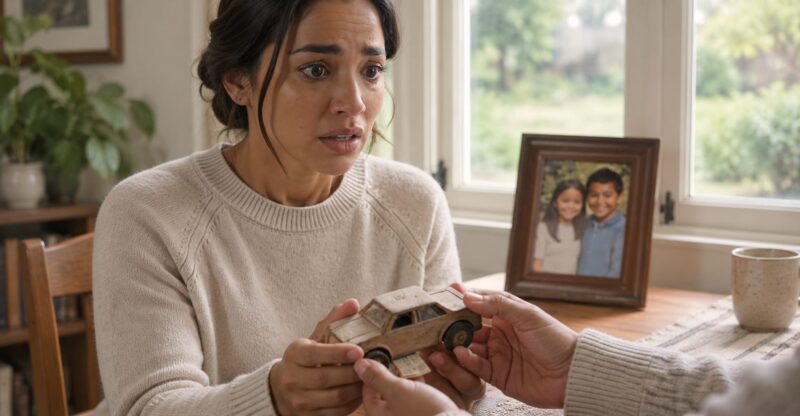
I turned toward an old family photograph resting against a box beside the wardrobe. It was not framed, just leaning there. In the picture, I was a little girl, and beside me stood a smiling boy holding the same toy car.
“He… disappeared from our lives many years ago,” I whispered.
Narek said nothing. He simply moved closer, as though he understood that this was not the moment for too many questions.
I looked at the car again and squeezed it a little more tightly.
That was when I felt the metal piece underneath move slightly.
At first, I thought it was simply because the toy was old and broken.
But then I ran my finger along the lower edge and noticed a thin section that looked almost like a tiny cover.
My heart began beating faster.
Carefully, I pressed it.
Something small slid out from inside.
I held my breath.
Hidden inside the toy was a tiny folded piece of paper.
“Mom, what is that?” Narek whispered.
I do not know why, but at that moment my fingers shook even more than when I first saw the car. The paper was so old that I was afraid it might tear. Very carefully, I unfolded it.
There were only a few words written inside, faded but still readable.
A name.
An address.
And a date.
I recognized the name.
It belonged to our aunt, Lusine, who had moved to another city many years earlier.
The address was unfamiliar to me.
The date was from around the same period when contact with Andranik had ended.
I sat down on the nearest chair because my legs suddenly felt weak.
Narek looked at me with wide eyes.
“Is it important?”
I looked at him and nodded.
“Yes. Very important.”
“Will it help us find him?”
The question tightened my throat.
For years, I had believed this story was over. That some wounds from the past simply remained unanswered forever.
But now, in my hands, hidden inside my brother’s favorite toy, was a clue that perhaps had not been left there by accident.
Maybe Andranik himself had hidden it.
Maybe he had wanted someone to find it one day.
I wiped the tears from my eyes and smiled at my son—for the first time that day not with sadness, but with hope.
“Maybe it will,” I said.
Narek sat beside me.
“Then are we going to look for him?”
I looked at the toy car, the little note, and the old photograph.
For years, our family had held on to silence as though it were safer than the truth.
But a small toy car hidden in an old wardrobe had suddenly opened a path that had seemed lost forever.
I took my son’s hand.
“Yes,” I answered softly. “We’re going to look for him.”
And in that moment, for the first time, I felt that perhaps our past had not been lost after all.
Maybe it had simply been waiting for someone to open the old wardrobe again.