That morning, while on patrol, I noticed a six-year-old boy sitting on the sidewalk, trying to sell his toys. In front of him were a little red car, a teddy bear, and a blue airplane. His eyes were filled with tears, and the paper cup he held contained only a few coins. I approached him and asked where his parents were. The boy lowered his head and whispered, “My mommy is in the hospital.” When I asked why he was selling his favorite toys, he replied, “I need money to make Mommy better.” Hearing those words, I immediately knelt in front of him. But the most heartbreaking moment was still to come. When I took the boy to the hospital and told the nurse his mother’s name, her expression suddenly changed. She asked me to wait in the hallway and hurried inside. A few minutes later, she returned holding a small envelope.
That morning, my shift began just like any other. I had been working in law enforcement for twenty years, and I thought I had already encountered almost every unexpected situation that life could bring.
But what I witnessed that day made me reconsider many things.
My name is David. I am forty years old, and I work as a police officer in a small American town. I’m married and have two children. My son, Daniel, is eight, and my daughter, Sophie, is five.
That morning, my partner and I were patrolling the downtown area. The weather was pleasant, the sun illuminated the streets, and people were hurrying to work.
At approximately eleven o’clock, I noticed a little boy sitting at the edge of the sidewalk.
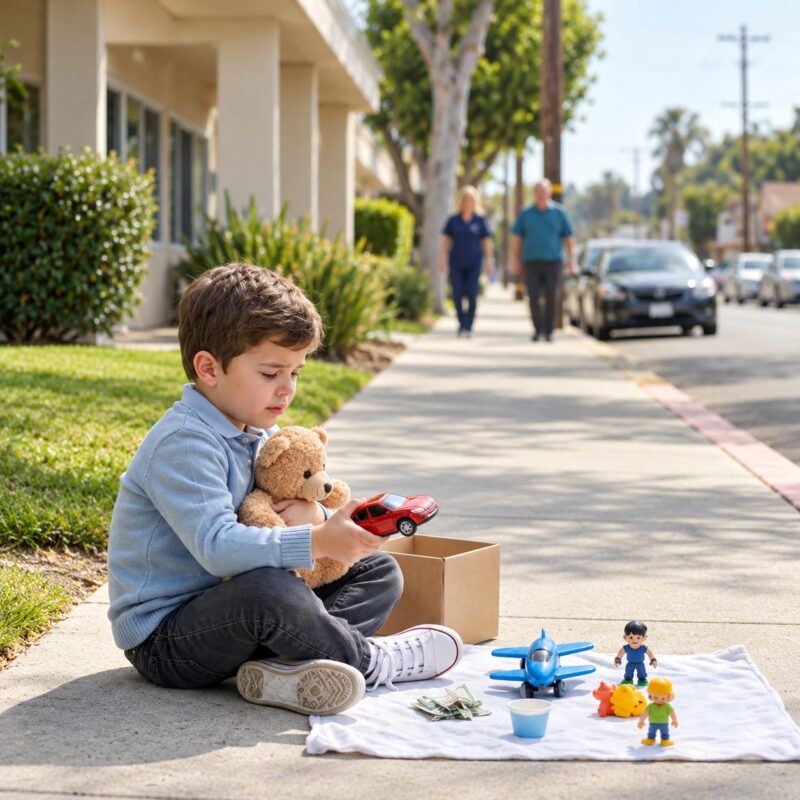
In front of him was an old blanket with several toys carefully arranged on it.
A little red car.
A blue airplane.
A teddy bear.
And a few small toy soldiers.
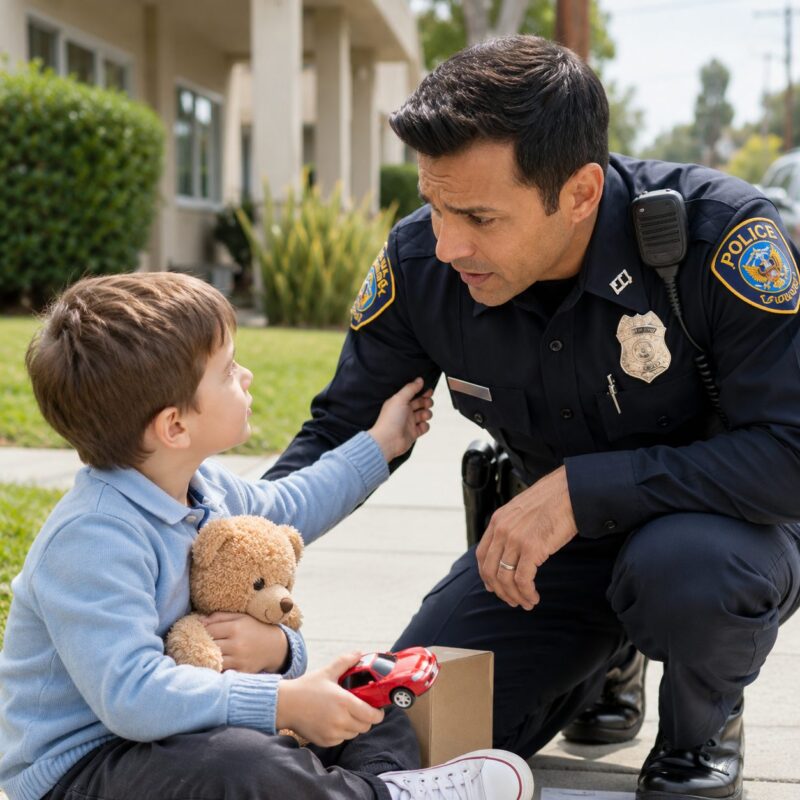
The boy sat behind a cardboard box, holding the red car in his hands.
“Please, buy my toys,” he said to passersby.
People walked past him.
Some smiled, while others didn’t even look at him.
But the child continued repeating the same request.
His voice was so quiet that I could barely hear him at first.
I approached.
The boy was about six years old. He had short light brown hair, large brown eyes, and a blue sweater.
His white sneakers were quite worn.
I noticed that his eyes were red from crying.
“Hello, little buddy,” I said, stopping in front of him.
The child raised his head.
When he saw my uniform, he became a little nervous.
“Hello.”
“What are you doing here?”
He immediately lifted the red car.
“Selling things.”
“How much does it cost?”
“Five dollars.”
I looked at the car.
It was old, with a small scratch on its side, and one of the front wheels barely turned.
But the boy held it as though it were the most precious thing in the world.
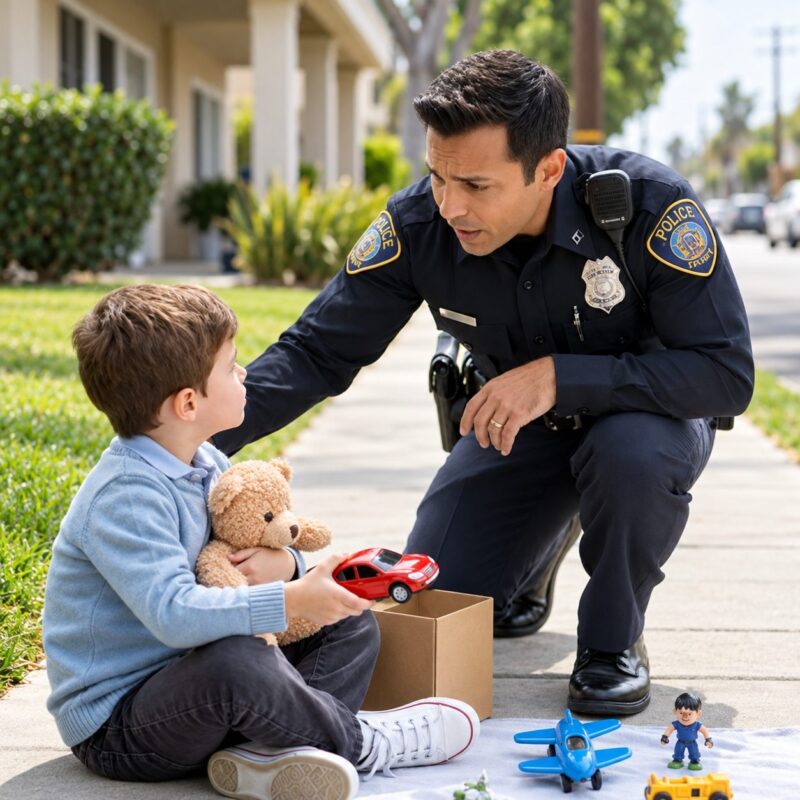
“Is this your favorite toy?”
He nodded.
“My daddy gave it to me.”
“Then why do you want to sell it?”
The boy fell silent.
His gaze dropped to a paper cup containing only a few coins and two crumpled dollar bills.
I knelt down so that my eyes were level with his.
“Where are your parents, little buddy?”
His lips trembled.
“My mommy is in the hospital.”
“And where is your daddy?”
The boy remained silent for a moment.
Then he answered quietly.
“Daddy doesn’t live with us anymore.”
I felt something tighten inside my chest.
“Who do you live with?”
“My mommy and my grandma.”
“Does your grandma know you’re here?”
The boy shook his head.
“She thinks I’m playing in the yard.”
I glanced at the people passing by, then looked at the child again.
“Why are you selling your toys?”
He squeezed the red car tightly.
Tears began rolling down his cheeks.
“Because Mommy is sick.”
I remained silent, waiting for him to continue.
“Yesterday, Grandma was talking on the phone. She said they needed a lot of money for Mommy.”
The child looked up at me.
“So I thought if I sold all my toys, the doctors would make Mommy better.”
Hearing those words, I felt a lump form in my throat.
The boy continued.
“I can live without my toys. But I can’t live without my mommy.”
For several seconds, I couldn’t say anything.
I thought about my own children.
I remembered how little Sophie had once cried when her mother went away for just two days to visit her parents.
But this boy didn’t know when he would be able to hug his mother again.
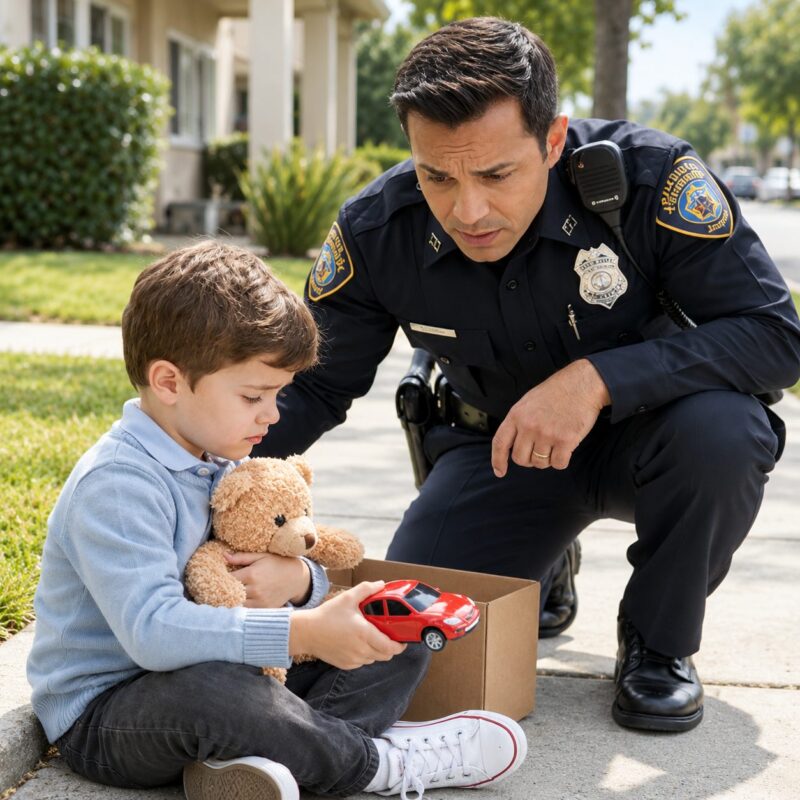
“What’s your name?” I asked.
“Noah.”
“Noah, listen to me. Your mommy’s treatment doesn’t depend on you selling your toys. You are not responsible for paying for it.”
He looked at me anxiously.
“But Grandma said we don’t have any money.”
“I understand. But there are people at the hospital who can help your family. First, let’s find your grandma.”
He wiped his tears with his sleeve.
“And then will you take me to Mommy?”
“Yes, if the doctors say it’s okay.”
For the first time, Noah managed a small smile.
I asked my partner to stay with us while I contacted the department.
Using the address the child gave us, we quickly located his grandmother.
The woman had become terribly worried when she realized her grandson was no longer in the yard.
Her name was Helen.
When I called and told her that Noah was safe with me, she began crying.
“Oh, thank God! I only went into the kitchen for a few minutes.”
A few minutes later, Helen arrived.
When Noah saw his grandmother, he ran straight into her arms.
“Grandma, please don’t be mad. I was trying to help Mommy.”
Helen looked at the toys in astonishment.
“Sweetheart, what have you done?”
“I was selling them so Mommy could come home.”
The woman covered her mouth with her hand.
Then she knelt and hugged her grandson tightly.
“My little boy, you don’t have to do anything like that.”
Noah began crying.
“But I want to see Mommy.”
Helen looked at me.
“His mother, Sarah, was admitted to the hospital three days ago. She has a heart condition. The doctors are running tests.”
I asked how she was doing.
“She was feeling better this morning. But we’re still waiting for the test results.”
I offered to accompany them to the hospital.
Helen agreed.
Before leaving, Noah began gathering his toys.
He picked up the little red car with particular care.
“My daddy bought this for my birthday,” he said.
“Then you should keep it,” I replied.
Noah looked at me.
“But what if Mommy needs more money?”
I placed my hand on his shoulder.
“The adults will take care of that. Your job is to be a child.”
He didn’t say anything.
He simply put the car into his pocket.
We reached the hospital about ten minutes later.
Noah sat silently beside his grandmother throughout the journey.
Only occasionally did he ask:
“Is Mommy awake yet?”
Helen gently squeezed his hand.
“Yes, sweetheart. She’s waiting for you.”
At the hospital, a middle-aged nurse greeted us.
When I mentioned the name Sarah Miller, her expression suddenly changed.
“Are you here with her son?”
“Yes.”
The nurse looked at Noah, then at Helen.
“Please wait here for a moment.”
She hurried down the hallway.
Noah took my hand.
“Officer, is something bad happening to Mommy?”
I immediately knelt beside him.
“We don’t know yet, little buddy. But we’ll ask.”
A few minutes later, the nurse returned.
She was holding a small envelope.
“Sarah wrote this yesterday evening,” she said. “She asked us to give it to her son if Noah came to visit while she was undergoing tests.”
Helen took the envelope.
Written on the front were the words:
“To My Dear Noah.”
The boy asked her to read it aloud.
Helen opened the letter.
Her voice trembled.
“My little hero,
I know you’ve been very frightened these past few days. I also know you’re trying to understand why Mommy isn’t home.
But I want you to remember one thing.
You don’t have to save me.
You already give me strength every day when you smile, when you draw pictures for me, and when you tell me you love me.
I want so much to come home, sit on our couch, and play with your red toy car together.
Please never think you have to give up your favorite things for me to get better.
You are my greatest treasure.
With all my love,
Mommy.”
When Helen finished reading, Noah covered his face with both hands.
Tears ran between his fingers.
“Mommy remembers my car,” he whispered.
At that moment, we heard the nurse’s voice from the other end of the hallway.
“Sarah has returned from her tests. You can go in now.”
Noah suddenly released my hand.
But instead of running toward the door, he turned and looked at me.
“Are you coming too?”
“If you want me to, yes.”
He took my hand again.
We entered the hospital room together.
A young woman of about thirty-two was lying in the bed.
She looked pale, but she was awake.
When she saw her son, she immediately smiled.
“Noah!”
The boy ran toward the bed.
“Mommy!”
Sarah carefully wrapped her arms around him.
Noah cried against his mother’s shoulder for a long time.
Then he took the red car out of his pocket.
“Mommy, I almost sold this.”
Sarah looked at him in surprise.
“Why, sweetheart?”
“So they could make you better.”
The woman held her son’s hand tightly.
“Noah, you are my precious boy. You don’t have to sell anything. The doctors are helping me.”
She kissed his forehead.
“I just want you to be safe.”
A little later, the doctor entered and explained that Sarah’s condition had stabilized. She still needed treatment and monitoring, but her latest test results were encouraging.
Noah asked:
“Does that mean Mommy can come home?”
The doctor smiled gently.
“If her recovery continues like this, we hope she’ll be home soon.”
For the first time that day, Noah smiled broadly.
Before leaving the hospital room, he approached me.
“Officer?”
“Yes, little buddy?”
“I want to give you something.”
He held out his blue toy airplane.
“This is for you because you helped me find Mommy.”
I knelt in front of him.
“Noah, you can keep your toys.”
But he stubbornly held out the airplane.
“I want you to have it.”
I accepted it.
“Thank you. I promise I’ll take good care of it.”
He stepped closer and hugged me.
I will never forget that hug.
Over the following days, I contacted the hospital’s social worker. With Helen’s permission, a meeting was arranged where the family learned about financial assistance for medical expenses and community support programs.
Several officers from our department also wanted to help.
We collected groceries and essential household supplies for the family.
A few weeks later, Helen called me.
There was happiness in her voice.
“David, I wanted to let you know that Sarah came home today.”
I smiled.
“That’s wonderful news.”
“And Noah has made something for you.”
The following day, they came to the police station.
Noah was holding a large sheet of white paper.
He had drawn three people.
A little boy.
A woman.
And a man wearing a police uniform.
At the top of the picture were the words:
“Thank you for helping me get to Mommy.”
Sarah approached me.
“I don’t know how to thank you. Noah told me that you said his job was to be a child.”
She paused for a moment.
“Those were exactly the words he needed to hear.”
That evening, I returned home earlier than usual.
My son and daughter were playing in the living room.
When they saw me, they ran into my arms.
I hugged them tightly.
My wife smiled in surprise.
“What happened today?”
I looked at my children and replied:
“Today, a little boy reminded me how precious a carefree childhood really is.”
Then I took the blue toy airplane out of my pocket.
Daniel looked at it curiously.
“Daddy, whose airplane is that?”
I smiled.
“It belongs to a very brave little boy.”
I now keep that airplane in a drawer in my office.
Sometimes, after a difficult shift, I take it out and remember Noah.
I remember his tear-filled eyes, his worn sneakers, and his little red car.
But most of all, I remember his words:
“I can live without my toys. But I can’t live without my mommy.”
That day, I understood that sometimes a child’s greatest fear is hidden behind the most ordinary action. And an adult’s most important responsibility is not simply to help, but to remind a child that they should never have to carry the weight of the entire world on their little shoulders.