The downtown bank was already crowded when the elderly man entered, the glass doors sliding open with a soft mechanical sigh that blended into the constant murmur of the hall. Inside, everything moved with disciplined predictability: people standing in lines, employees tapping on keyboards, security cameras slowly sweeping the room like silent observers.
The old man stepped in quietly, wearing a dark worn coat that had clearly seen many winters, and holding a small faded notebook tied with an old leather strap. He stopped just inside the entrance for a moment, as if orienting himself not to the space, but to a memory only he could access. No one paid special attention at first. In places like this, anonymity was normal, even expected. 💼
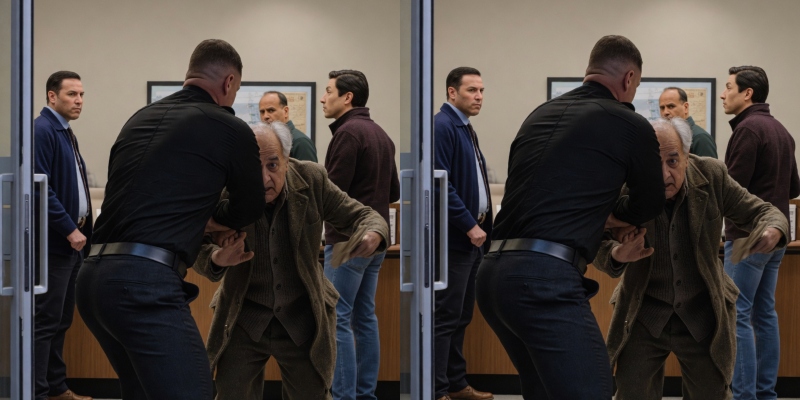
But the security guard noticed him almost immediately. The guard’s posture shifted in that familiar way of someone used to controlling the flow of people through authority alone. He walked over without hesitation, already assuming the situation before a single word was exchanged. His voice was sharp, designed more for control than conversation. “Sir, if you don’t have business here, you need to leave,” he said firmly. A few people nearby turned their heads.
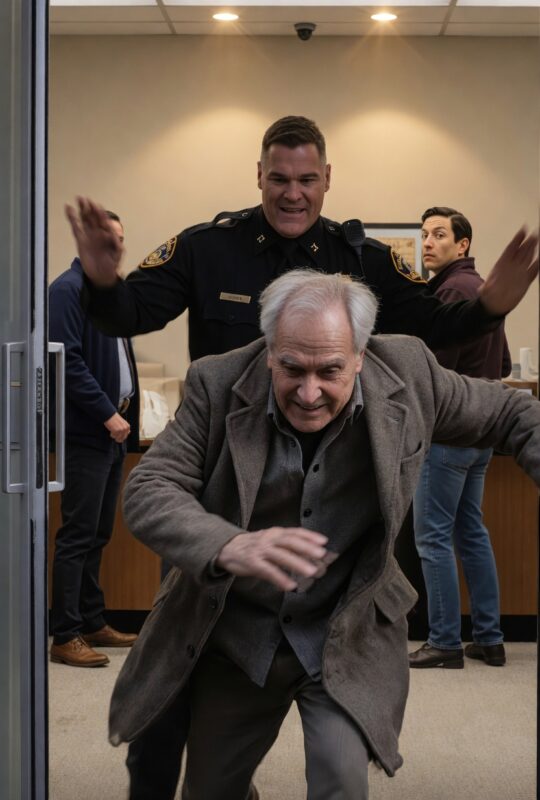
The elderly man didn’t react quickly. He adjusted his coat slowly, then lifted his eyes—calm, steady, and strangely unaffected by the tone directed at him. “I do have business here,” he said softly. “I need to complete a withdrawal.” The guard let out a short, dismissive laugh, loud enough for others to hear. A couple of customers smiled awkwardly, while others looked away, avoiding involvement. The man simply looked down at his notebook for a brief moment, then toward the bank’s illuminated logo above the counters, as if measuring time against something older than the building itself. 🕰️
He opened the notebook. Inside, it wasn’t just paper. A thin metallic interface was embedded within the pages, almost invisible unless someone knew exactly where to look. His thumb pressed a small recessed button. CLICK. The sound was quiet, almost unimpressive. At first, nothing changed. The guard smirked slightly, convinced that this was just another meaningless gesture. But within seconds, the atmosphere inside the bank shifted. A faint mechanical sequence echoed through the structure.
One by one, systems reacted. The automatic doors at the entrance froze mid-motion. The security gates inside the building halted halfway down. Payment terminals flickered and went dark. Then came the sound—layered, synchronized, unmistakable. CLACK. CLACK. CLACK. Every access point in the building locked at once. The room fell into silence so sudden it felt unnatural. ⚠️
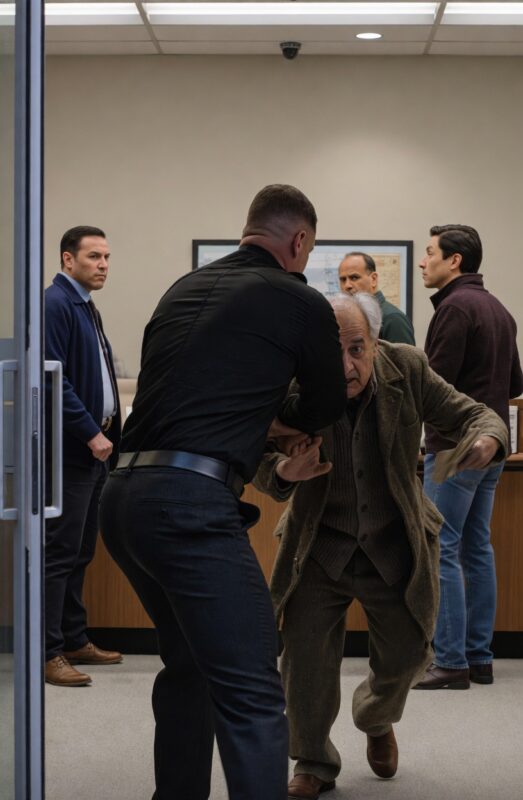
People stopped moving. Employees froze mid-task. A man holding a card near a scanner pulled it back slowly, unsure if touching anything would make it worse. The guard’s expression changed for the first time—confidence replaced by confusion. “What is happening?” he muttered under his breath, scanning the room for answers that didn’t exist. The elderly man, however, remained completely still. He closed the notebook with quiet precision, as though concluding a chapter only he could read. He did not look surprised. He did not look alarmed. He simply waited. 💼
The branch manager rushed out of his office almost immediately, his tie slightly disorganized, his face already carrying the tension of someone trying to control an uncontrollable situation. “Report the system failure!” he called out, looking between employees and frozen screens. But the moment his eyes landed on the elderly man, his voice faltered.
His expression changed instantly—from confusion to recognition, and then to something closer to disbelief. “Señor Velasco…” he said quietly. The guard frowned, stepping closer. “Sir, this man disrupted the system. I was handling it—” But the manager raised his hand sharply, stopping him without even looking in his direction. The room became heavier with silence. Everyone could feel that the situation had shifted beyond normal procedure. 😶
Velasco stood calmly, holding the notebook at his side. “I didn’t come to disrupt anything,” he said. “I came to see what remained of what I built.” That sentence landed differently than anything before it. The manager swallowed hard. “We didn’t know your access key still existed in the system,” he said. “It shouldn’t have responded.” Velasco gave a small, almost thoughtful nod, as if this outcome had been expected all along. Around them, the bank felt different now—not just locked, but exposed. As if something hidden beneath its modern surface had finally surfaced. 🏦
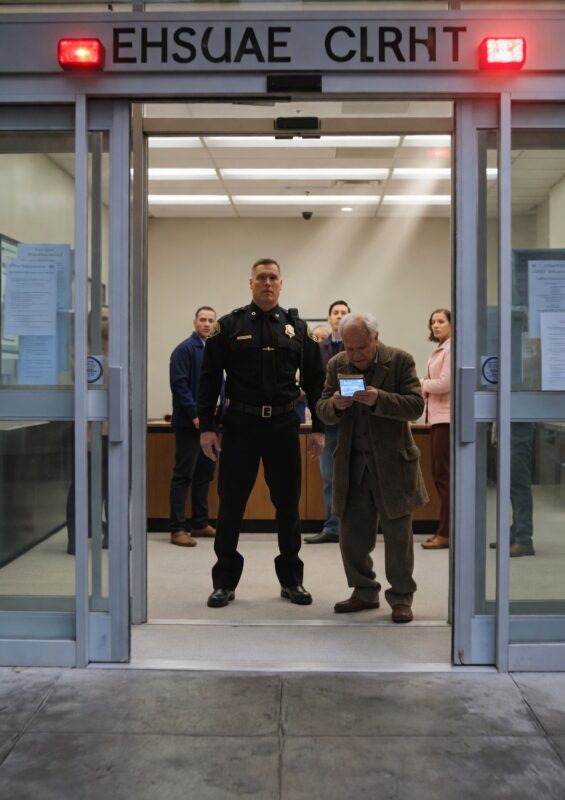
The guard took a small step backward, uncertainty replacing authority. “You built this?” he asked quietly. Velasco turned his gaze toward him. “Not this version,” he replied. “But enough of it that the system still remembers my signature.” A heavy silence followed. Then Velasco added, more quietly, “Systems don’t forget creators. People do.” The manager lowered his head slightly, unable to respond. Employees stood still, unsure whether to continue working or simply wait. The usual structure of the bank had collapsed into observation. 🧭
Velasco looked around the room once more. “Security was never meant to exclude,” he said calmly. “It was meant to recognize.” He paused. “But recognition requires understanding. And understanding requires attention.” The words hung in the air without resistance. No one interrupted. No one argued. Even the guard remained silent now, absorbing what had been said without defense. 😶
The manager finally spoke again, carefully. “We can restore full access immediately. Just tell us what you need.” Velasco shook his head slowly. “Nothing is broken,” he said. “This system is functioning exactly as it was designed.” That statement unsettled the room more than the lockdown itself. Because it implied intention rather than failure. 📉
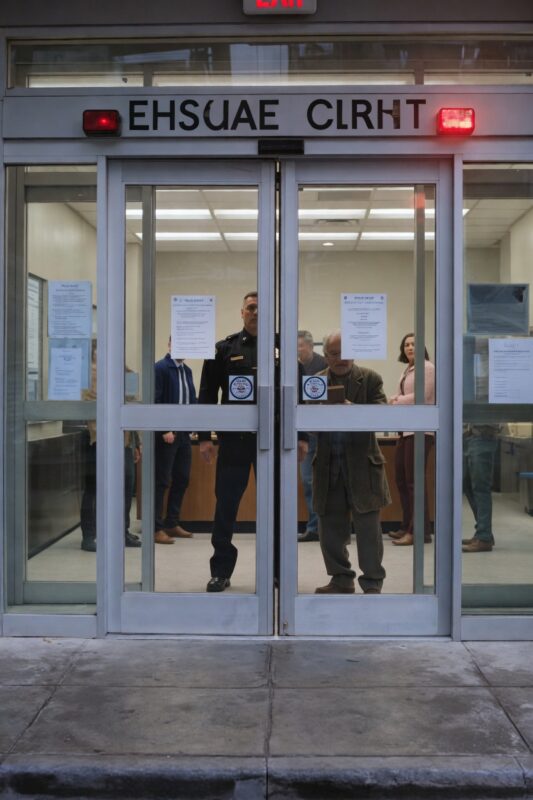
He lifted the notebook slightly. “This contains the original framework. Not just code—but purpose. The idea that a system should recognize intent before rejecting presence.” He turned slightly toward the guard. “You saw a man and assigned a category. That is human instinct. But this place was built to rise above instinct.” The guard looked down, no longer defensive, only reflective. 🕰️
Velasco walked toward the exit doors. As he approached, the system responded instantly. Locks disengaged in reverse order. CLACK. The doors unlocked. The screens stabilized. The bank returned to motion, slowly, like a machine remembering how to breathe. Relief spread quietly through the room, though no one spoke it aloud. 🌙
At the doorway, Velasco paused without turning fully back. “Authority without understanding becomes noise,” he said softly. “And systems without memory become dangerous.” Then, after a pause, he added, “Next time, ask a name before you decide a role.” 🧭
He stepped outside and disappeared into the city, blending into the movement of people as if he had never interrupted anything at all. Inside the bank, silence lingered a moment longer than usual. The manager stood still, staring at the restored system. The guard remained near the entrance, no longer rigid, but thoughtful. Something had changed—not in the machines, but in the way everyone now looked at them.