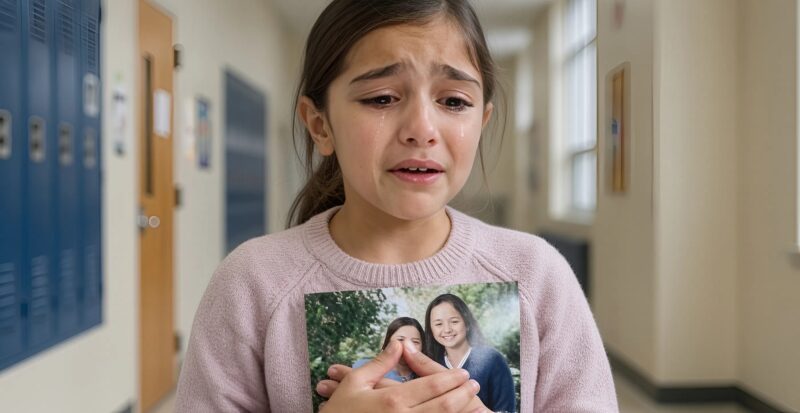
“You’re a thief! Open your backpack right now!” the teacher shouted across the school hallway. I was only nine years old, and I was terrified, clutching my old backpack tightly against my chest. Students had gathered around us. Some were whispering, while others simply stared at me. Through my tears, I kept repeating that I hadn’t taken anything, but Mrs. Wilson didn’t believe me. When I finally opened my backpack, several medical prescriptions and a photograph of my mother sitting in a wheelchair fell onto the floor. The teacher froze. I knelt down, picked up the photograph, and confessed that I saved money every day, hoping to help my mother walk again. But at that moment, nobody knew why I was refusing to show the other pocket of my backpack. And when the teacher finally discovered the little secret I had hidden there, her eyes filled with tears.

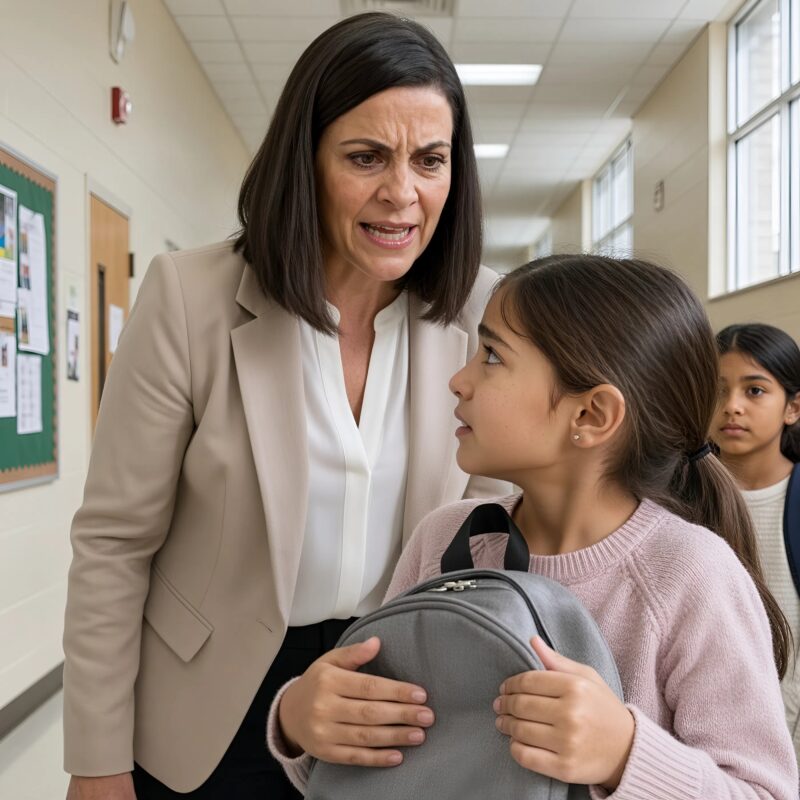
“YOU’RE A THIEF! OPEN YOUR BACKPACK RIGHT NOW!”
Mrs. Wilson’s loud voice echoed throughout the school hallway.
I froze.
My hands tightened around my gray backpack.
“Please, I didn’t steal anything,” I barely managed to whisper.
“Then open it!”
The students standing around me fell silent.
Just a few seconds earlier, everyone had been hurrying toward their classrooms. Now almost the entire hallway was watching us.
I could see familiar faces.
My classmate Olivia was standing beside a blue locker.
Two boys next to her were whispering something to each other.
I wanted to disappear.
My name is Emma. I’m nine years old.
That morning, I had come to school wearing the same old pink sweater I wore almost every week.
The sleeves were slightly too long, and my shoes were already worn out.
My mother always told me that the price of someone’s clothes didn’t determine their worth.
I believed her.
But at that moment, with everyone staring at me, I felt ashamed even of my clothes for the first time.
“Emma, I’m telling you for the last time,” the teacher said. “Open your backpack.”
I sobbed.
“Please, don’t make me.”
Mrs. Wilson’s expression became even sterner.
“If you haven’t taken anything, why are you afraid?”
I didn’t answer.
How could I explain that I wasn’t afraid of opening my backpack?
I was afraid of what everyone would see inside.
Everything had begun just twenty minutes earlier.
Our class had organized a small charity fundraiser.
The students were collecting money to buy new books for the school library.
The money was kept in a white envelope inside the teacher’s desk drawer.
That morning, the envelope had disappeared.
I had been one of the first students to enter the classroom.
Mrs. Wilson had seen me standing near her desk.
But she didn’t know why I had been there.
I wanted to leave her a little letter.
I had written it the night before.
I wanted to ask her to help me find an organization that could provide information about rehabilitation treatment for my mother.
But when I noticed the teacher entering the classroom, I became nervous.
I quickly put the letter back into my backpack.
She asked:
“What were you doing near my desk?”
Frightened, I answered:
“Nothing, ma’am.”
That single word made everything much worse.
When the envelope containing the money was discovered missing, Mrs. Wilson remembered my strange behavior.
And now, in front of the entire school hallway, she was convinced that I had taken it.
“Emma, put your backpack on the bench,” she ordered.
I slowly walked toward a bench beside the wall.
My tears made everything look blurry.
I placed my backpack down.
I grabbed the zipper.
My fingers were trembling so badly that I failed to open it several times.
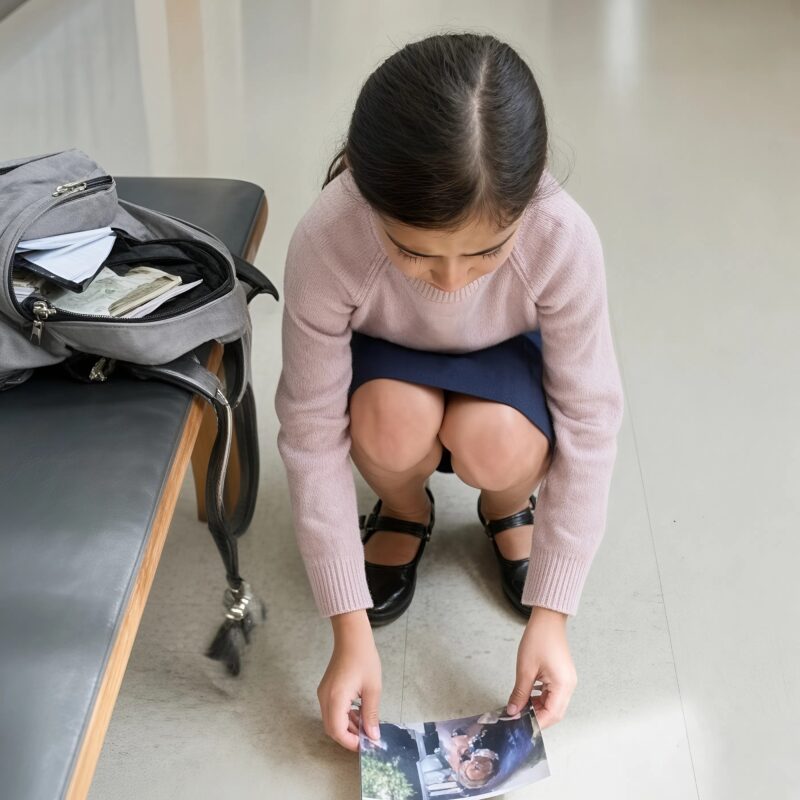
Finally, the backpack opened.
Several folded papers slipped out and fell onto the floor.
A small photograph fell out after them.
Mrs. Wilson looked down.
“What are these?”
I quickly dropped to my knees.
I picked up the photograph and pressed it against my chest.
It was a picture of my mother.
She was sitting in a wheelchair, and I was standing beside her.
We were both smiling.
The photograph had been taken on her birthday.
That day, I had given her flowers made from paper.
Mrs. Wilson picked up one of the papers lying on the floor.
It was one of my mother’s medical prescriptions.
She read the name.
“Anna Miller?”
I nodded.
“That’s my mommy.”
The teacher’s voice changed.
“Emma, why are you bringing these documents to school?”
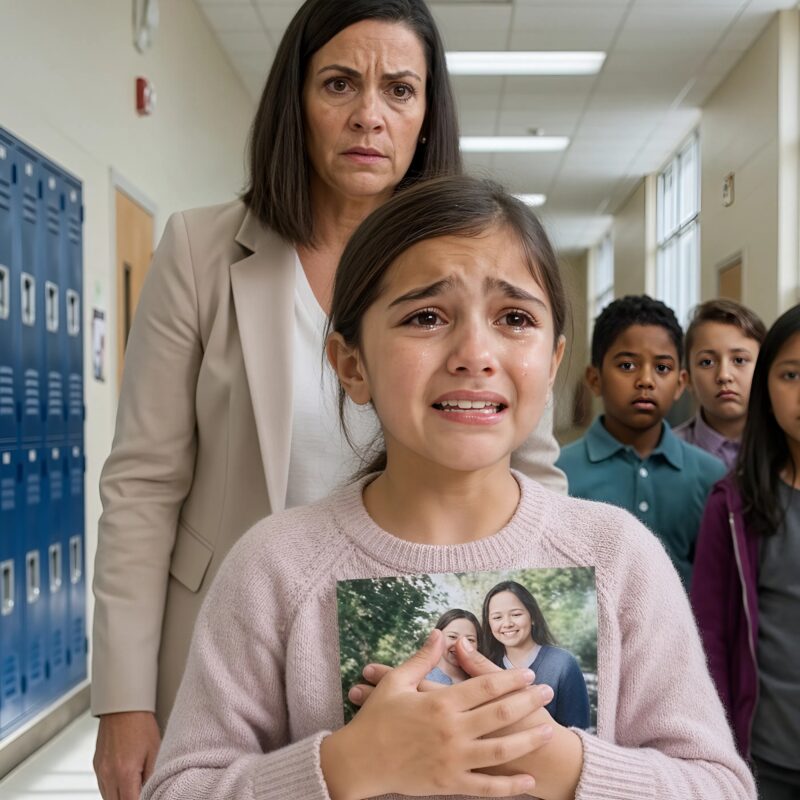
I could no longer hold back my tears.
“Because I save money every day.”
“What for?”
I raised the photograph.
“So my mommy can walk again one day.”
Mrs. Wilson fell silent.
None of the children standing around me were whispering anymore.
But that still wasn’t the whole story.
Two years earlier, our lives had been completely different.
I lived with my mother and father in a small but bright house.
My mother worked in a flower shop.
She loved roses, especially yellow ones.
Every evening, she brought home small flowers left over from the shop and placed them on the kitchen table.
My father was an auto mechanic.
On Saturdays, the three of us went for walks together.
My favorite thing was running through the park with my mother.
She always pretended that she couldn’t catch me.
I would turn around, laughing, and shout:
“Mommy, faster!”
She would answer:
“Wait for me, my little runner!”
But one day, my mother developed a serious health problem.
She spent a long time receiving treatment in the hospital.
When she returned home, she could no longer walk independently.
At first, I thought it was temporary.
Every morning, I asked:
“Mommy, will you walk today?”
She would smile.
“We’re making a little progress every day, sweetheart.”
The doctors had prescribed rehabilitation therapy.
They explained that progress might be slow and that the results couldn’t be guaranteed in advance.
But my mother never lost hope.
My father worked longer hours.
He tried to cover the rent, medications, and treatment expenses.
He often returned home exhausted.
Sometimes I heard my parents quietly discussing money in the kitchen.
They thought I was asleep.
But I was listening.
One evening, my mother said:
“I don’t want Emma to feel the weight of our difficulties.”
My father replied:
“She’s still a child. She should be allowed to just be a child.”
I lay in bed thinking about those words for a long time.
The next day, I decided that I could help too.
I started saving my pocket money.
Whenever my father gave me a few coins, I didn’t spend them.
I also tried to save the money meant for school lunches whenever I brought food from home.
I saved every bit of money I received for my birthday.
I had a small box.
On it, I had written:
“For Mommy’s First Step.”
Every evening, I opened the box and counted the money I had collected.
The amount wasn’t large.
But I felt that every coin brought my mother a little closer to her dream.
One day, she noticed the box.
“Emma, what’s this?”
I quickly hid it.
“It’s a surprise.”
She smiled.
“All right. I won’t ask.”
That was when I decided to make copies of some of her medical documents.
I wanted to show them to an adult at school who might explain where we could ask for help.
That was exactly why I had written a letter to Mrs. Wilson.
But I felt embarrassed.
I didn’t want my entire class to know about my family’s difficulties.
Most of all, I didn’t want everyone to start feeling sorry for me.
That was why I had been so afraid to open my backpack.
Mrs. Wilson was still standing in front of me.
She held my mother’s medical documents in her hands.
“Emma,” she said in a much softer voice, “why didn’t you tell me?”
I wiped my eyes.
“Because I didn’t want everyone to hear.”
She looked around.
The children were still standing there.
The teacher asked them to return to their classrooms.
Then she looked at me again.
“I should never have accused you in front of everyone.”
I remained silent.
At that moment, she noticed the small front pocket of my backpack.
Its zipper was partly open.
A folded pink piece of paper was visible inside.
“And what’s this?”
I quickly took it out.
“It was for you.”
Mrs. Wilson looked surprised.
“For me?”
I quietly handed her the letter.
She opened it.
Written in my uneven handwriting were the words:
“Dear Mrs. Wilson,
You always tell us that adults can help children. I don’t want to ask for money. I want to know if there’s somewhere that can help my mommy with her treatment.
I’ve already started saving money, but I still have very little.
Please don’t tell anyone.
I want my mommy to smile again the way she used to.”
Mrs. Wilson read the entire letter.
Then she read it a second time.
When she raised her head, her eyes were filled with tears.
“Emma, forgive me.”
It was the first time I had ever seen her cry.
She had always been strict.
She always spoke loudly.
And she never showed her feelings.
Now she knelt down so that her eyes were level with mine.
“I was wrong,” she said. “I accused you without making sure what had actually happened.”
I asked:
“Do you still think I’m a thief?”
She immediately shook her head.
“No, Emma. And I need to make that clear in front of everyone.”
At that moment, the assistant principal appeared in the hallway.
He was holding a white envelope.
“Mrs. Wilson, we found the missing money.”
The teacher turned in surprise.
“Where was it?”
“With the library paperwork. You gave it to the librarian yourself yesterday so the donations could be counted.”
Mrs. Wilson closed her eyes for a moment.
I looked at her.
Her face had turned red.
She knelt in front of me again.
“Emma, you didn’t steal anything. I’m deeply sorry.”
I wanted to say something, but I couldn’t find my voice.
She asked:
“Can you give me a chance to make things right?”
I nodded.
That day, at the beginning of class, Mrs. Wilson explained to all the students that the money had been found and that I had nothing to do with its disappearance.
She also apologized to me in front of everyone.
But she said nothing about my letter.
That was our agreement.
After classes, she invited me into her office.
The school counselor was already waiting there.
They asked whether I would like them to speak with my mother about available support programs.
I agreed.
The next day, my mother came to school.
My father helped her inside.
When I saw my mother in her wheelchair in the hallway, I stopped for a moment.
Usually, I didn’t like it when people stared at her for too long.
But this time, nobody looked at her with surprise.
Mrs. Wilson approached my mother.
“Mrs. Miller, your daughter is a very thoughtful and caring child.”
My mother smiled.
“I know.”
The teacher told her about my letter.
My mother turned toward me.
“Emma, were you doing all this for me?”
I nodded shyly.
“I wanted us to run in the park again.”
My mother began to cry.
She opened her arms.
I walked over and hugged her.
“My little girl,” she whispered, “you don’t have to raise money for my treatment.”
I replied:
“But I want to help.”
She kissed my forehead.
“You already help me. Every single day.”
The school counselor gave my parents information about rehabilitation services, social assistance programs, and organizations that might be able to help.
Together, they filled out the necessary applications.
The results weren’t known immediately.
But for the first time, my father said that we no longer had to search for solutions to every problem on our own.
A few weeks later, my mother began attending additional rehabilitation sessions.
Sometimes I accompanied her.
I watched as she performed exercises with the help of a specialist.
I applauded even the smallest sign of progress.
But my mother taught me something very important.
“Emma, even if I can’t walk the way I used to, that doesn’t mean our happiness has to end.”
I looked at her.
“But will we still go to the park?”
She laughed.
“Of course. And you’ll try to be faster than me again.”
Several months passed.
My mother’s condition gradually improved.
She continued using her wheelchair, but during certain exercises, she was able to stand with professional assistance.
The doctors reminded us that recovery took time and that nobody could predict exactly what progress she would make.
We learned to celebrate small victories.
One day, I came home from school and found my mother arranging flowers in the kitchen.
There were yellow roses on the table.
“Where did these come from?” I asked.
She smiled.
“From my old workplace. They offered me the chance to help arrange orders from home a few days a week.”
I hugged her with excitement.
That evening, the smell of flowers filled our kitchen again.
My father came home and smiled for a long time when he saw us.
He said:
“It feels like our home is filling with colors again.”
I remembered that morning at school when everyone thought I was a thief.
I remembered my teacher’s angry face.
Then I remembered how her expression had changed when she read my letter.
Mrs. Wilson had changed after that incident too.
She no longer rushed to judge children.
If a student behaved strangely, she first spoke with them privately and calmly asked whether they needed help.
Our class even started a small initiative where students could write anonymous letters if they were facing difficulties.
One day, she told me:
“Emma, you taught me something very important.”
I was surprised.
“Me? But you’re the teacher.”
She smiled.
“Teachers have things to learn too.”
From that day on, I was no longer afraid of my old gray backpack.
I still used it.
Inside, I kept my books, notebooks, and my mother’s photograph.
But now, whenever I looked at that picture, I didn’t think about the things my mother couldn’t do.
I thought about her smile.
About how she tried to move forward every day.
And about the fact that our family was no longer facing its difficulties alone.
One evening, I opened my little savings box.
My father asked:
“Emma, what are you planning to do with the money you’ve saved?”
I thought for a moment.
Then I answered:
“I want to buy yellow roses for Mommy. And I’ll save the rest for our next family outing.”
My father smiled.
“That’s a wonderful idea.”
The following week, the three of us went to the park.
My mother was in her wheelchair.
My father walked beside her.
I ran ahead of them.
At one point, I turned around and shouted:
“Mommy, faster!”
My mother laughed.
“Wait for me, my little runner!”
Those were the same words she had said to me years earlier.
I stopped.
I ran back to her and hugged her tightly.
At that moment, I understood that our happiness had never depended entirely on whether my mother could walk.
Our happiness came from being together.
And from the love that had never changed, even during our hardest days.
From then on, I no longer hid my mother’s photograph.
I was proud of her.
I was proud of my father.
And for the first time, I was proud of myself too.
Because at just nine years old, I had understood something that even adults sometimes forget.
You cannot judge someone by their clothes, their silence, or what they hide inside their backpack.
Sometimes the quietest child carries the greatest worries in their little heart.
And sometimes one kind question can accomplish more than a hundred harsh accusations.
I will never forget that morning when my teacher called me a thief in front of everyone.
But I will also remember the moment she knelt before me, admitted her mistake, and offered to help.
Because that day, it wasn’t just medical papers and a photograph that fell out of my backpack.
That day, a little girl’s enormous dream was revealed.
And I realized that money isn’t the only thing that matters when you’re trying to make a dream come true.
Sometimes, what matters most is having someone willing to listen to you, believe in you, and help you feel that you are no longer alone.