For several weeks, I had noticed that my eleven-year-old son was leaving home earlier than usual every morning. At first, I thought he simply wanted to get to school early or meet his friends along the way. But then I began to feel there was something secretive about the way he rushed out. One morning, I decided to follow him from a distance. I watched as he stopped near an old gate, pulled a small container from his backpack, and fed a dog that was waiting for him. I still did not understand why he was doing this every day. But when I saw him walk into the yard afterward and approach an elderly man who lived alone, placing water and groceries beside him, I realized that my son had not been hiding something bad from me. He had been quietly hiding an act of kindness he had never told anyone about.
Over the past few weeks, I had started noticing a small but persistent change in my son’s behavior.
Aram was eleven years old, and normally I had to remind him at least twice every morning to hurry up for school. But suddenly, everything changed. He started waking up early on his own, getting dressed quickly, grabbing his backpack, and saying:
“Mom, I’m leaving.”
At first, it actually seemed like a positive change. But then I noticed that he was leaving almost twenty minutes earlier than usual. Whenever I asked why he was in such a hurry, he simply shrugged.
“I just want to go early.”
The answer was too short, and I knew my son well enough to understand that he was not telling me everything.
One morning, when he left early again, I decided to follow him.
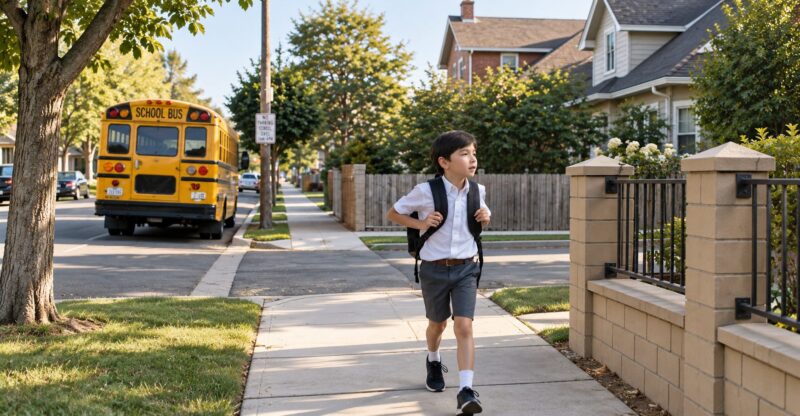
I waited for a moment, then quietly stepped outside and walked behind him, making sure he did not notice me. The morning was peaceful. Soft daylight covered the street, the leaves barely moved in the trees, and the sidewalk leading toward the school was almost empty.
Aram walked quickly, but instead of continuing straight toward school, he stopped beside an old gate, looked around, and opened his backpack.
I immediately stopped behind a tree.
He pulled out a small plastic container.
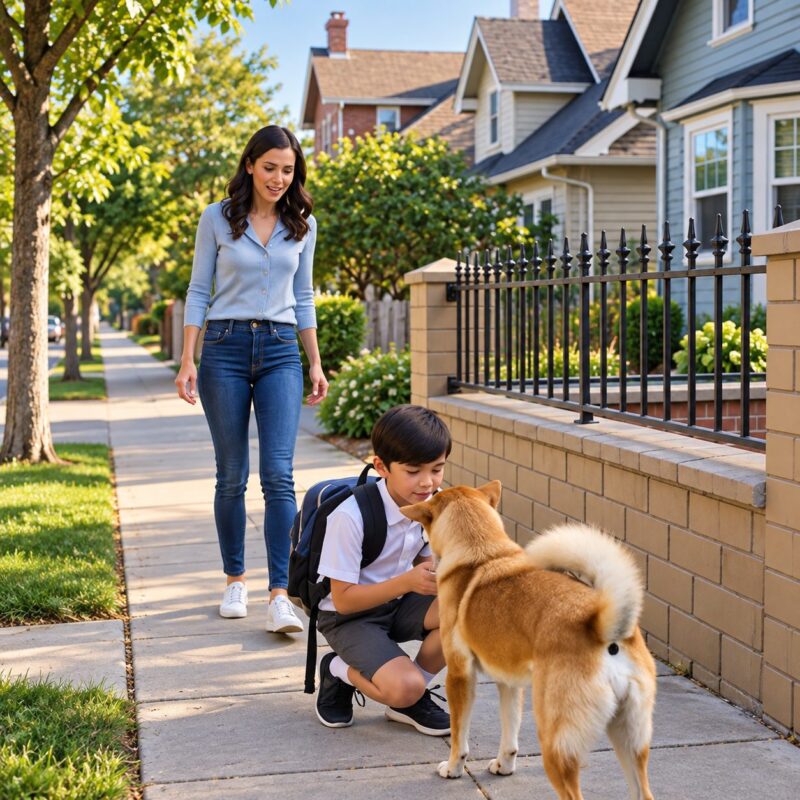
At that moment, a brown dog with kind eyes came running from the yard, wagging its tail excitedly. Aram knelt down, smiled, and opened the container.
“Here you go,” he whispered. “You must be hungry.”
The dog began eating while Aram gently stroked its head.
I stood there frozen.
For a moment, I even smiled. But then another question came to mind: if this was the reason, why was he hiding it from me? And more importantly, why was he doing it every morning?
Aram stayed with the dog for a few more moments, then stood up.
I thought he would finally continue toward school.
But he did not.
Instead, he walked through the half-open gate.
Surprised, I stayed where I was for a moment, then slowly moved closer.
The yard was small and modest. There was an old house, several flowerpots, a worn chair against the wall, and a tiny porch.
The dog walked ahead and led Aram toward the porch.
An elderly man was sitting there.
He looked about seventy-five years old, thin, with white hair and a kind but tired face. A small old table stood near his feet.
Aram walked up to him and pulled a small grocery bag from his backpack.
“Good morning, Grandpa Hakob,” he said.
“Aram, my boy, you came again?” the elderly man said with a smile.
My son placed the bag on the small table, then set a bottle of water beside it.
“Yes,” he replied. “You said yesterday that your legs still hurt. I thought I should at least bring these.”
The elderly man smiled gently.
“You don’t have to trouble yourself every day.”
“But you’re alone,” Aram replied simply. “And Benny needs to be fed too.”
That was when I understood that the dog’s name was Benny.
I stood near the gate, unable to move.
My eyes began filling with tears.
My son, whom I still thought of as a little boy, was not only feeding the dog every morning.
He was helping an elderly man who lived alone.
I slowly stepped into the yard.
Benny noticed me first and began wagging his tail.

Then Aram turned around.
Surprise immediately appeared on his face.
“Mom?”
The elderly man looked at me too, slightly confused.
For several seconds, I said nothing.
I simply looked at my son with a feeling that was difficult to describe.
Surprise.
Guilt.
Emotion.
And enormous pride.
“So this is why you leave early every morning…” I said quietly.
Aram lowered his head.
“Sorry, Mom… I didn’t want you to be angry.”
“Angry?” I repeated in surprise.
He shrugged awkwardly.
“I thought you would say I might be late for school, or that I shouldn’t go into someone else’s yard without telling you.”
I walked closer.
“Why didn’t you tell me?”
Aram was silent for a moment, then looked toward Grandpa Hakob.
“One day I saw that he was having trouble walking, and Benny was sitting near the gate. I stopped and fed him. Then Grandpa came outside and told me that sometimes even going to the shop was difficult for him. The next day, I brought some bread. Then… it just continued.”
Grandpa Hakob added softly:
“Your son has a big heart. He’s been helping me for several weeks. Sometimes he brings a bottle of water, sometimes bread or yogurt. But the most important thing is that he sits with me for a few minutes and talks. When a person lives alone, sometimes it is the silence that becomes the hardest thing.”
By then, I could no longer hide my tears.
I knelt in front of Aram and hugged him.
“You really thought you had to hide this from me?” I asked softly.
He hugged me tightly.
“I didn’t want you to think I was doing something stupid.”
I smiled through my tears.
“You weren’t doing something stupid. You were doing something very important.”
That morning, for the first time, I stayed longer in Grandpa Hakob’s yard with Aram.
We carried the groceries inside, tidied the small table, and filled Benny’s water bowl.
Then I suggested that we come back together after school.
We made sure Aram was not late for class, but that morning I looked at my son differently.
That evening, when we returned home, I kept thinking about what had happened.

For days, I had worried that Aram was hiding something bad from me.
But in reality, he had been hiding kindness.
Kindness without expecting praise.
Without making a fuss.
Without telling anyone.
After that day, Aram no longer left home secretly in the mornings.
But he continued stopping at the same gate.
Sometimes we brought food for Benny together.
Sometimes we bought groceries for Grandpa Hakob.
And every time, I thought about the same thing.
Sometimes children are not hiding mistakes from us.
Sometimes they are quietly hiding a kind of goodness that we adults still have something to learn from.