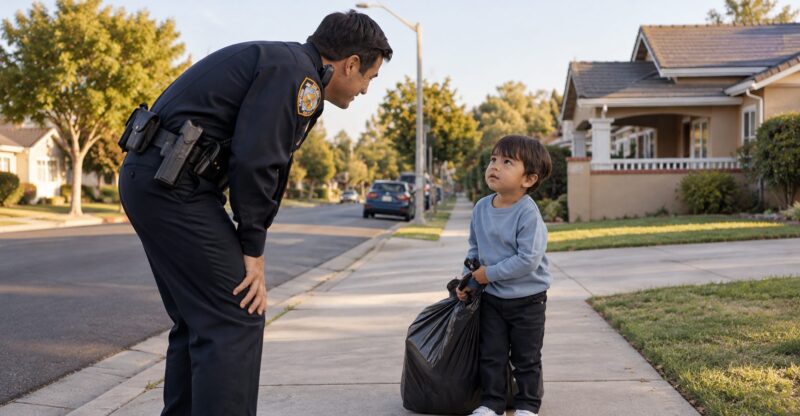
While on police patrol, I noticed a three-year-old boy dragging a huge black bag down the street, almost as big as himself. I approached him and smilingly asked where he was taking so much trash. “I’m helping Mommy,” he replied. When I asked where his mother was, the little boy whispered, “She’s home. She’s crying.” I opened the bag and found a family photo album among old clothes, toys, and shoes. A sentence written on the back of one photograph made me immediately contact the police station. The boy grabbed my uniform sleeve and asked, “Will you help my mommy?” At that moment, I had no idea that when I opened the door of their house, I would meet a woman whose name I had already seen in official police documents. But the most surprising thing was that the information about her family told a completely different story from the belongings I had found in the little boy’s bag.
That morning, my patrol shift had started just like any other. The weather was sunny, the streets were quiet, and the residents of the neighborhood were busy with their daily routines. I had been a police officer for fifteen years, and I believed that almost nothing in our small town could surprise me anymore. But that day, a three-year-old boy changed the way I thought about people’s lives and how enormous secrets can sometimes be hidden behind the most ordinary things.
At around eleven o’clock, I was driving slowly down a tree-lined residential street when I noticed something unusual on the sidewalk.
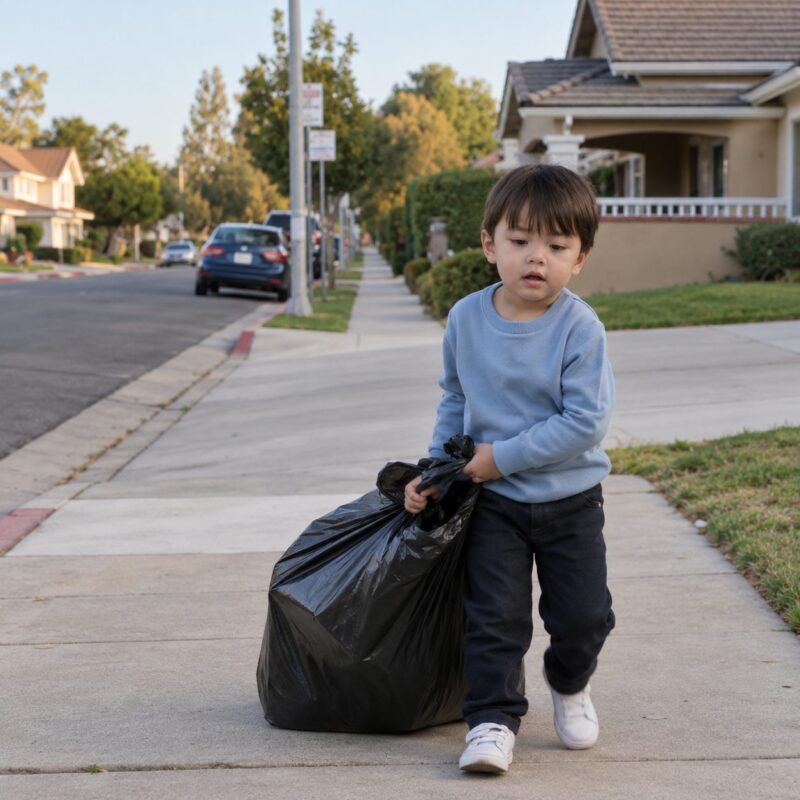
A little boy was dragging an enormous black plastic bag with both hands. It was almost as tall as he was. The child took a few steps, stopped to catch his breath, and then tried to move forward again. His light blue sweater was slightly oversized, there was dust on the knees of his trousers, and his little white sneakers struggled to move forward under the weight of the heavy bag.
At first, I couldn’t help smiling.
I assumed his parents were probably cleaning something in their yard and the little boy had decided to help them.
I stopped my patrol car, got out, and approached him.
“Hello there, young man! What’s that enormous bag you’re carrying?”
The boy stopped and raised his head.
His brown eyes looked remarkably serious.
“It’s trash,” he answered in a soft, childish voice.
“Trash? And where are you taking it?”
He pointed toward the other end of the street.
“To throw it away.”
“And where’s your mommy?”
After that question, the child’s expression changed. He was no longer smiling. He looked down at the bag and then back at me.
“She’s home.”
“And why isn’t she with you?”
The little boy remained silent for a few seconds.

“Mommy’s crying.”
I immediately knelt in front of him.
“Why is your mommy crying?”
“I don’t know. She says we have to go.”
I looked at the heavy bag. It was completely full, but there was no way to tell what was inside.
“And who put all these things in here?”
“Mommy.”
“Did she tell you to throw them away?”
The boy nodded.
“She said we don’t need them anymore.”
That answer seemed strange. A three-year-old child couldn’t possibly understand why the family’s belongings needed to be thrown away. His mother probably hadn’t imagined how far the little boy might wander while dragging such a heavy bag.
“Can I see what’s inside?” I asked.
The boy agreed.
I carefully opened the bag.
Inside were old men’s clothes, worn-out shoes, several children’s toys, a small blanket, and a thick family photo album. Everything had been carefully folded. None of it looked like trash.
I picked up the album.
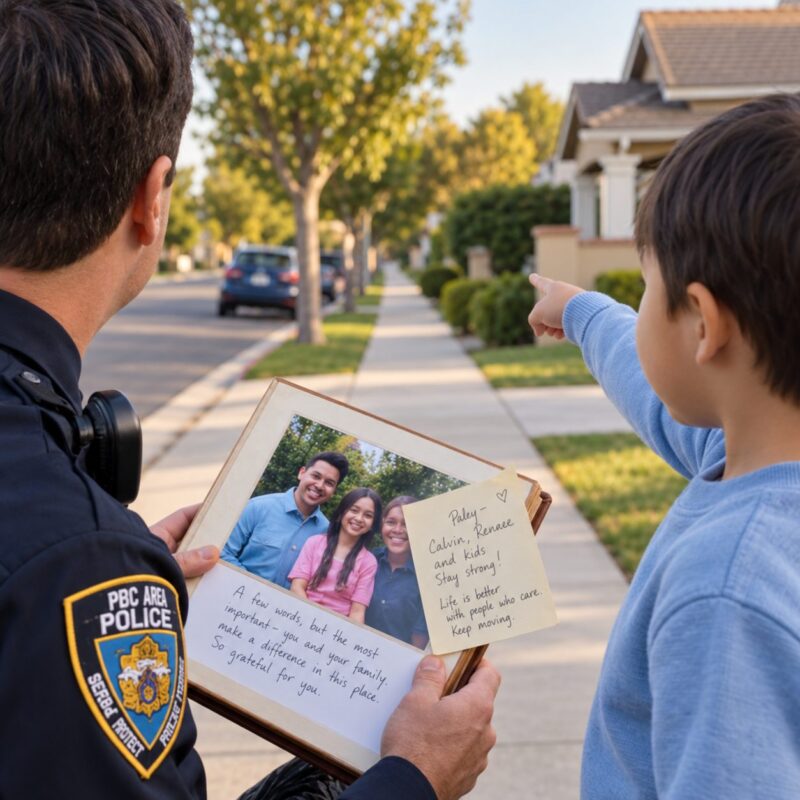
On the first page was a photograph of a young family: a father, a mother, and two children. The woman was smiling, the man was holding a little girl in his arms, and a boy stood beside them with a toy car.
The child standing next to me pointed at the photograph.
“That’s me.”
“And who’s this little girl?”
“My sister, Emma.”
“And where’s your daddy?”
The boy looked at the picture and quietly said,
“He’s far away.”
I turned to the next page.
There was another photograph. The family stood in front of a house, holding a set of keys. Beneath the picture was written:
“Our first home. We finally made our dream come true.”
But there was another message on the back of the photograph.
“If we ever have to leave, remember that this house is for our children’s future.”
Beneath the message was a man’s signature: Daniel Miller.
The name immediately sounded familiar.
A few days earlier, a woman had contacted our police department about a legal problem involving her home. Her husband, Daniel Miller, had traveled to another state for a long-term work contract. During his absence, the family had received a notice demanding that they vacate the property, even though the woman was certain that they had made every payment on time.
The case was still under review.
I looked at the little boy.
“Is your mommy’s name Sarah?”
He immediately nodded.
“Yes!”
Now I understood that I had accidentally encountered the child of the very family whose situation was already known to our department.
I picked up my radio and asked my colleagues to check the latest information concerning the case.
Meanwhile, the little boy grabbed the sleeve of my uniform.

“Mister Police Officer…”
“I’m listening, little buddy.”
“Will you help my mommy?”
There was so much hope in his voice that, for a moment, I couldn’t answer.
“I’ll do everything I can. Now, can you show me where you live?”
I picked up the bag and asked the child to walk beside me.
At the end of the street stood a small white house with a blue front door. Several cardboard boxes were sitting in the yard. Children’s drawings hung near the window, and a little bicycle stood beside the entrance.
We approached the house.
The front door was slightly open.
“Mommy!” the boy called.
I heard quick footsteps coming from inside.
A young woman appeared in the doorway. Her eyes were red, and her face looked exhausted. When she saw her son standing beside a police officer, she hurried toward us anxiously.
“Tommy! Where have you been? I’ve been looking everywhere for you!”
She knelt and hugged her son tightly.
“Mommy, I took out the trash,” the boy said proudly.
The woman looked at the black bag in my hand and froze.
“Where did you get that?”
“It was by the door.”
Her eyes filled with tears again.
I introduced myself and explained where I had found her son.
Sarah thanked me and invited me inside.
Almost everything in the living room had been packed into cardboard boxes. A large family photograph still hung on the wall. Documents, payment receipts, and an envelope containing an official notice were scattered across the table.
“We’re supposed to leave today,” Sarah said.
“Why today?”
She handed me the papers.
It turned out that a discrepancy had appeared in the family’s housing documents. Their most recent payments hadn’t been recorded in the system, and the company responsible for managing the property had demanded that they vacate the house.
Sarah had repeatedly tried to contact the people responsible, but she hadn’t received a clear answer.
“My husband is very far away right now,” she explained. “He calls every day and tries to help, but I’m handling everything here on my own. With two children, I don’t even know where we’re supposed to go.”
She sat down on a chair and covered her face with her hands.
“This house is our entire life.”
I asked where Emma was.
“She’s at our neighbor’s house. Our neighbor has been helping me look after the children.”
Tommy approached his mother and placed his little hand on her knee.
“Mommy, don’t cry.”
Sarah tried to smile.
“Everything will be okay, sweetheart.”
But I could see in her eyes that she wasn’t sure of that herself.
Just then, my radio crackled with a response from the station.
My colleague informed me that new documents had been received regarding Sarah’s case. The bank had confirmed that the family’s most recent payments had been made on time. The problem had been caused by a system error, and the legal basis for the demand to vacate the property still needed to be examined.
I asked my colleagues to forward all the necessary information to the appropriate authorities and immediately contacted a specialist responsible for housing matters.
Sarah silently watched the conversation.
When I finished the call, she asked anxiously,
“What’s happening?”
“It turns out there’s been a mistake with your payment records. You should have an opportunity to present the evidence. Until the situation has been properly clarified, it’s important that you don’t make any decisions based solely on verbal demands.”
For the first time, a glimmer of hope appeared on her face.
“Does that mean we might not have to leave?”
“That still needs to be confirmed by the responsible authorities, but we already have information that could help you protect your rights.”
Sarah emotionally took my hands.
“You have no idea what this means to us.”
I looked at Tommy.
He was sitting on the floor, playing with a little toy car he had taken out of the bag.
“Actually, your son is the one who brought me here,” I said.
Sarah looked at him in surprise.
Then I showed her the family photo album.
“This was inside the bag, too.”
The woman took it with trembling hands.
“I never wanted to throw this away,” she whispered. “I was just packing things I didn’t know where to take. Tommy must have heard me saying that we would have to give up some of our belongings.”
She opened the album and stopped at the photograph with the message about the house written on the back.
She stared at it for a long time.
“Daniel worked for years to buy this house,” she said. “We wanted our children to grow up here.”
Tommy approached her.
“Mommy, this isn’t trash?”
Sarah hugged him.
“No, sweetheart. This is our family’s story.”
The child smiled.
“Then let’s keep it.”
“We certainly will.”
That day, with the help of my colleagues and the appropriate specialists, we managed to arrange an urgent review of the documents. The company responsible for managing the property received confirmation of the payments and agreed to suspend its demand that the family move out until all the information had been thoroughly checked.
A few days later, it was confirmed that the problem really had been caused by an error in the payment records. The family was able to remain in their home.
When I returned to inform them of the final decision, Sarah opened the door with a smile.
The cardboard boxes were no longer stacked around the house. The toys had been returned to their places, flowers stood on the windowsill, and the family photo album rested on the living room table.
Tommy ran toward me.
“Mister Police Officer, are we staying?”
I knelt in front of him.
“Yes, little buddy. You’re staying in your home.”
He clapped his hands with joy and ran toward his mother.
Sarah thanked me with tears in her eyes.
But before I left, she stopped me.
“Do you know what Tommy said yesterday?”
“What did he say?”
“He said that when he grows up, he wants to become a police officer because police officers know how to make mommies smile again.”
After hearing those words, I couldn’t speak for a long moment.
Throughout my career, I had encountered many different situations, but this family’s story remained especially vivid in my memory.
It had all started with a little child dragging a black bag almost as big as himself, believing that he was simply helping his mother get rid of unwanted belongings.
But in reality, that bag contained much more than old clothes and toys. It held an entire family’s memories, dreams, and the life they had spent years building.
When I turned around for one last look at their house, I saw Tommy standing by the window. He had raised his little hand and was waving goodbye with a smile.
I waved back.
That day, I realized that sometimes the most important help begins not with a dramatic event, but with one simple question:
“Little buddy, what’s inside that bag?”
And sometimes, a child’s most innocent action can become the first step toward changing an entire family’s future.