For several weeks, my wife had been hiding something from me. She often spoke quietly on the phone, sometimes came home late after work, and gave vague, incomplete answers whenever I asked questions. I tried to convince myself that I was overthinking things, but my worry grew every day. Then, one afternoon, I saw her inside an orphanage office signing documents with an unfamiliar employee, and my heart tightened. I imagined the worst. But a few minutes later, I discovered a truth that did not destroy us—it brought back a hope we had lost years earlier. My wife was not betraying me in secret. She was trying to fulfill the dream we had once spoken about during one of our most painful and honest nights: giving a child a home and a family.
That day had begun like any other, but for several weeks I had already felt that something in our home had changed.
My wife, Anna, had never been a particularly secretive person. We had been married for nine years, and during all that time we had learned to speak openly even about the most painful things.
That was exactly why her recent behavior was bothering me.

She often answered her phone and walked into another room. Sometimes she came home from work exhausted but carrying a strange tension inside her, as though she had spent the whole day not simply working, but carrying the weight of some difficult decision.
One evening, I walked into the bedroom and saw that she had taken down an old box from the top shelf of the closet. We kept old papers, photographs, and letters from years ago inside it.
The moment she noticed me, she quickly closed the box.
“What are you looking for?” I asked.
She smiled, but the smile did not feel completely natural.
“Just sorting through some old things,” she said.
“What things?”
She was quiet for a moment, then added:
“I’ll tell you later.”
That “later” began to worry me more than it probably should have.
There was one subject that had been painful for us to talk about for years.
A child.
At first, we had both believed it was simply a matter of time.
Then came the examinations.
The disappointments.
Hope.
Then disappointment again.
Over the years, the subject became a delicate wound that we spoke about very carefully.
Sometimes it even felt as though we had stopped discussing it completely because we were afraid another unfulfilled hope might break us.
But one night, about three years earlier, when neither of us could sleep, Anna quietly said:
“You know… if one day we cannot have a child of our own, maybe we could change someone else’s life.”
I knew what she meant.
“Adoption?” I asked.

She nodded.
We talked for a very long time that night.
Not as two people giving up on a dream, but as two people trying to find another way to love.
Then life carried us forward again, and that conversation remained somewhere in the distance—never forgotten, but never continued.
That memory had begun quietly returning to me when, one day, I noticed that Anna had not come home from work at her usual time.
I called her.
She answered quickly.
“I’ll be a little late.”
“Where are you?”
“I have something to take care of. We’ll talk at home.”
But when she came home, she barely said anything.
The next day, it happened again.
Several weeks passed like that.
Then one afternoon, when she hurried out of the house, I decided to follow her.
Even now, I feel a little ashamed when I remember that decision, but at the time I felt as though I had no other choice.
Anna walked several streets and then stopped in front of a building.
The sign indicated that it was an orphanage.
For a moment, I thought I must have misunderstood what I was seeing.
She went inside.
I stood outside with my heart pounding, then finally overcame my hesitation and followed her.
The hallway was bright and clean.
Soft afternoon light came through the windows.
I could hear children’s voices somewhere in the building.
I walked slowly until I reached a half-open office door.
Inside, Anna was sitting at a desk across from a woman who looked about fifty.
Folders, official documents, and a pen lay on the table.

The woman slid another paper toward Anna and pointed to a place on the page.
Anna took a deep breath and signed it.
I froze.
What was she doing here?
Why had she not told me?
What decision was being made without me?
She picked up the pen again, and I could no longer remain standing in the doorway.
I walked inside.
Anna immediately looked up.
Her face changed instantly.
“Arman…”
The social worker quietly looked at me.
I stepped closer to the table and glanced at the documents, but from where I stood I could not understand what they were.
“Why didn’t you tell me about this?” was all I could say.
There was accusation in my voice, but even more than that, there was hurt.
Anna’s eyes filled with tears.
She slowly stood.
“I wanted to tell you when everything was more certain.”
“What do you mean, certain?”
The social worker gently closed the folder, as though she understood that this was the moment when the documents needed to remain silent and the people needed to speak.
Anna came closer and took my hand.
“Do you remember the promise we made to each other years ago?”
I frowned.
“What promise?”
She swallowed her emotion.
“That if one day we could… we would give a child a home. A family.”
I stared at her without saying anything.
She continued.
“A few months ago, I started thinking about it again. At first, I was only gathering information. Then I came here. They started explaining the process to me. I was afraid to tell you too soon. I was afraid that if something went wrong, we would both be hurt all over again.”
Her words struck exactly where years of silent pain had been buried.
“So… you came here because…”
“Yes,” she whispered. “I was trying to make our old dream come true.”
I did not know what to feel.
Was I hurt that she had kept it from me?
Yes.
Was I overwhelmed by what she had been trying to do?
Completely.
Then the social worker spoke softly.
“If you would like… I think it may be time.”
She walked to the door and opened it toward the hallway.
I turned.
Far down the corridor stood a small child.
About five or six years old.
A little backpack rested on her shoulders.
Her hands were tightly clasped together, and she was looking toward us with wide, cautious eyes.
For a moment, the whole world seemed to go silent.
I felt Anna squeeze my hand more tightly.
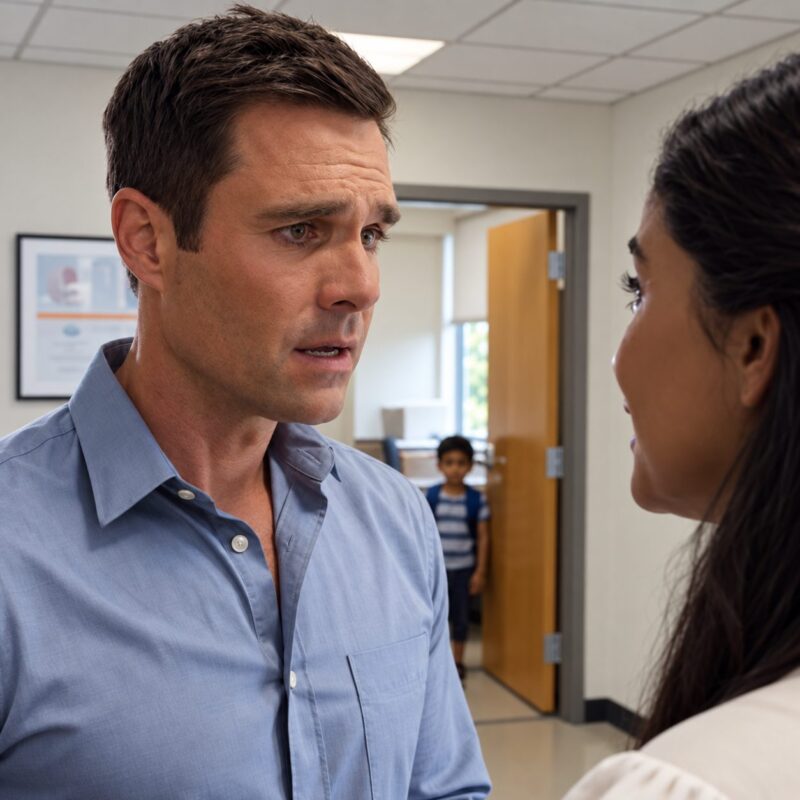
“Her name is Liana,” she whispered. “I didn’t want to tell you anything until we knew for sure they would allow us to meet her.”
The little girl did not move.
Not exactly out of fear.
Not exactly out of distrust.
It was the kind of careful hope that exists only in the eyes of children who have learned far too early not to believe too quickly.
I looked at Anna.
There was both fear and hope in her eyes.
As though she was waiting to see what I would say, what I would feel, what decision I would make.
And in that moment, I finally understood the most important thing.
She had not hidden this because she no longer wanted me in her life.
She had hidden it because she was afraid of hurting both of us again if the hope failed.
I took several steps into the hallway.
Liana remained where she was.
Then she slowly took one step forward, almost as if she were testing whether it was safe.
I knelt down so I would be at her eye level.
“Hi,” I said.
She looked at me silently.
“I’m Arman.”
She hesitated, then answered very quietly:
“I’m Liana.”
Her voice was so soft that my chest tightened.
Anna came to stand beside us.
“We really wanted to meet you,” she said.
Liana looked at Anna, then at me.
For the first time, something gentle appeared in her expression.
“Will you come again?” she asked.
That question broke something inside me completely.
Not “Who are you?”
Not “Why are you here?”
But:
“Will you come again?”
Because life had already taught her one painful lesson too early—people sometimes come, but they do not always stay.
My eyes filled with tears.
“Yes,” I said. “If you want us to, we will come again.”
Anna could no longer hold back her tears.
The social worker quietly turned away, as though she wanted to leave the three of us alone inside that small but enormous moment.
I had entered that orphanage carrying suspicion, hurt, and fear.
But I walked out with a feeling I had not experienced in a very long time.
Hope.
Not the kind of hope that makes loud promises.
The quiet, trembling kind that appears when you realize that sometimes life gives back a dream you had already learned to hide silently inside yourself.
And as we walked out through that bright hallway, I knew only one thing for certain.
Behind that door was not simply a little child.
There stood the purest possibility born from years of unfulfilled longing—
the possibility of finally giving someone a home,
and perhaps, for the first time, becoming a truly complete family.