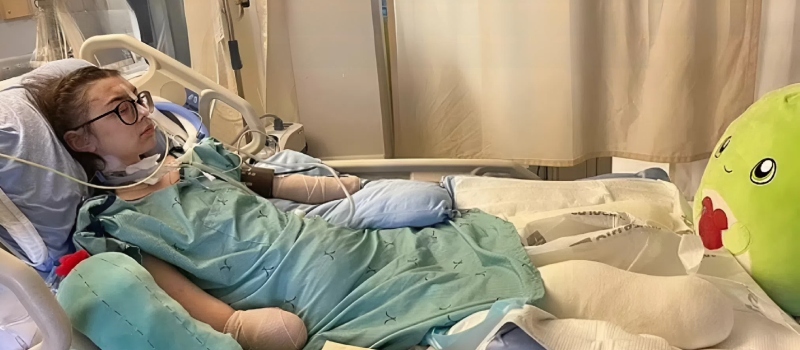
Amalie Henze had always considered herself prepared for life’s challenges. At 19, living with Crohn’s disease, she had endured countless hospital stays, surgeries, and flare-ups. When she went in for a routine bowel surgery in the fall of 2023, she expected the usual discomforts—a few days of IV morphine, a feeding tube, and the predictable routines that had become all too familiar. She never imagined that what seemed like another ordinary recovery could turn into a nightmare. 😔
At first, Amalie brushed off the sharp cramps and unusual fatigue she began feeling. “It’s just my Crohn’s acting up again,” she thought. She had grown accustomed to these symptoms over the years. But when her hands and feet started feeling unusually cold and numb, she realized something was off. By the time a nurse tried to take her blood pressure, the sight of her limbs turning purple made everyone panic.
She was quickly diagnosed with septic shock, a life-threatening condition triggered by a severe infection. The doctors explained that the infection had progressed rapidly, leaving no choice but to put her into a medically-induced coma to give her body the best chance to fight it. 🏥
When Amalie woke up a month later, the first thing she noticed was the absence of familiar sensations in her hands and feet. Her family and medical team gently prepared her for the devastating news: her limbs had suffered irreversible damage and would need to be amputated.
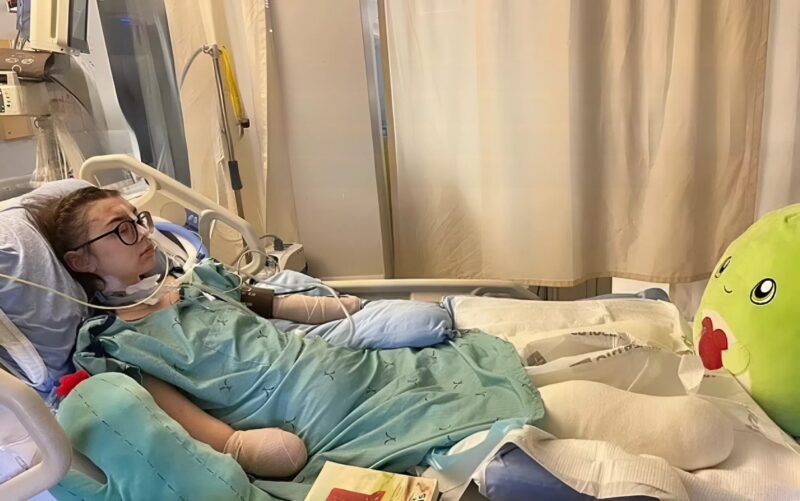
“I knew something was wrong, but I had no idea it would be this extreme,” she recalled. The doctors carefully explained what had happened while shielding her from seeing the full extent of the damage at first. The moment she finally caught sight of her foot, dark and blackened, a wave of shock and disbelief washed over her. 🖤
The recovery process was grueling. Amalie had a tracheostomy and feeding tube, which made even simple tasks like talking or eating almost impossible. She was transferred between hospitals three times—ICU to ICU, then finally to a rehabilitation facility specializing in amputees. Each transfer brought new challenges: learning to navigate life without her hands and feet, coping with pain, and accepting that she would need to rely on others for basic care. Yet, amidst the struggle, she found a strange sense of clarity. She realized that this ordeal would reveal who her true friends were and who could empathize with her journey, however imperfectly. 💔
As the weeks turned into months, Amalie began exploring the world of prosthetics. She learned about advanced technology, adaptive devices, and ways to regain independence. She discovered that losing her limbs didn’t have to define her life; instead, it could be a gateway to new possibilities. She started documenting her experiences on TikTok, sharing the raw, unfiltered highs and lows of her journey. Followers from all over the world reached out with encouragement, turning her trauma into a source of inspiration. 🌍

Despite her optimism, there were moments of profound frustration. Being dependent on her family for the simplest of tasks challenged her fiercely independent spirit. “I’ve always been self-reliant, so needing help with everything was a mental hurdle I wasn’t ready for,” Amalie admitted. Yet, there were silver linings. The infection that had cost her limbs had, unexpectedly, put her Crohn’s disease into remission. For years, she had struggled with medications and flare-ups, and now her disease was finally under control. 🩺
Amalie’s journey took a new twist when she received her first set of prosthetic limbs. The moment she stood on her own, albeit shakily, an overwhelming sense of empowerment flooded her. She could walk, grasp objects, and reclaim a semblance of normalcy. It was a victory that felt both monumental and surreal. She realized that the body could endure unimaginable loss, yet the mind and spirit could adapt and flourish. 💪

What surprised Amalie most, however, was how her experience changed her perspective on relationships and connection. Some friends had drifted away, unable to handle her trauma, while others showed unwavering support, often in ways she never expected. It was a lesson she had learned the hard way: true friendship isn’t measured in words or proximity, but in consistency, empathy, and effort. She grew closer to her family, who had stood by her every step of the way, and she learned to appreciate the small acts of kindness that had once gone unnoticed. ❤️
Then came the moment that would forever alter her sense of possibility. While attending a rehabilitation event for young amputees, Amalie met a researcher developing experimental neural-interface prosthetics—a technology that could, theoretically, restore some sense of touch to artificial limbs. The prospect seemed almost fantastical, like something out of a sci-fi novel. Yet here it was, real and tangible. Amalie volunteered to participate in the trial, fueled by curiosity and the desire to reclaim a part of herself she thought she had lost forever. 🤯

Months later, she returned to the lab, and for the first time since her coma, she felt it: the faint, electrifying sensation of pressure through her prosthetic fingers. A soft brush of a towel, the gentle squeeze of a friend’s hand—it was miraculous. Tears streamed down her face as she realized she could feel the world again in a way she never thought possible. The technology was still in its early stages, but for Amalie, it symbolized hope, resilience, and the unbreakable human spirit. ✨
Looking back, Amalie understood that her journey had been cruel yet transformative. From the terrifying onset of septic shock to losing her limbs and discovering the frontier of prosthetic technology, every twist had forced her to confront fear, pain, and vulnerability. Yet she emerged stronger, wiser, and more empathetic than ever.

Life had taken away parts of her body, but it had gifted her perspective, purpose, and the extraordinary potential to feel, live, and inspire in ways she had never imagined. 🌈
As she stepped out of the lab that day, prosthetics clicking beneath her, Amalie smiled. The world looked the same, yet everything had changed. She had faced the abyss and returned, not just surviving, but thriving. And somewhere deep inside, she carried a secret joy: the infection that had nearly ended her life had inadvertently set her on a path to something greater—a life not defined by what she had lost, but by the incredible journey she was only beginning to embrace. 🌟