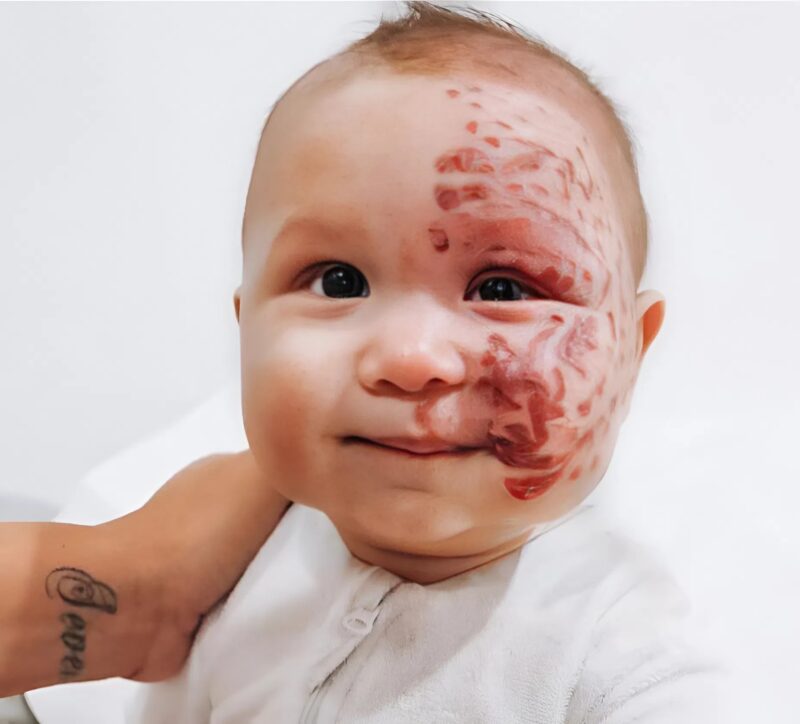
The day Kingsley was born, I remember staring at his tiny face and feeling my heart twist in ways I couldn’t fully understand. The room was quiet—too quiet—while nurses exchanged glances they thought I wouldn’t notice. I held him close, inhaling that warm newborn scent, and tried to ignore the dark crimson mark covering the left side of his face. At first, I thought it was simply a bruise from birth. But then the doctor cleared his throat, that subtle sound that instantly freezes a mother’s blood.
He explained gently, almost whispering, that Kingsley had a port-wine stain. I heard the words, but they were swallowed by a louder fear rising inside me. When he mentioned the risks—glaucoma, neurological complications—the room seemed to tilt. I nodded, pretending to absorb everything, but all I could think was, *My baby. My tiny, perfect baby.* 💔
Kewene tried to be strong for me, but later that night, when the hospital lights dimmed and the world fell silent, he cried too. I saw it in the faint trembling of his shoulders. We clung to each other like two people lost at sea, praying the waves would not pull our son under.
Over the next few weeks, our lives became a blur of appointments, tests, whispered observations, and the constant buzzing of medical machines. Sometimes I felt like Kingsley was more a patient than a child. I longed to simply enjoy him, to laugh at his little yawns, to delight in his first attempts at lifting his head. But fear wrapped itself around every moment, turning even joy into something fragile.
The worst day came when the eye specialist told us the pressure in Kingsley’s left eye had increased again. His tiny lashes fluttered while they examined him, completely unaware of the danger closing in around him. I held his hand, so small that it barely wrapped around the tip of my finger, and promised him I would fight for him no matter what.
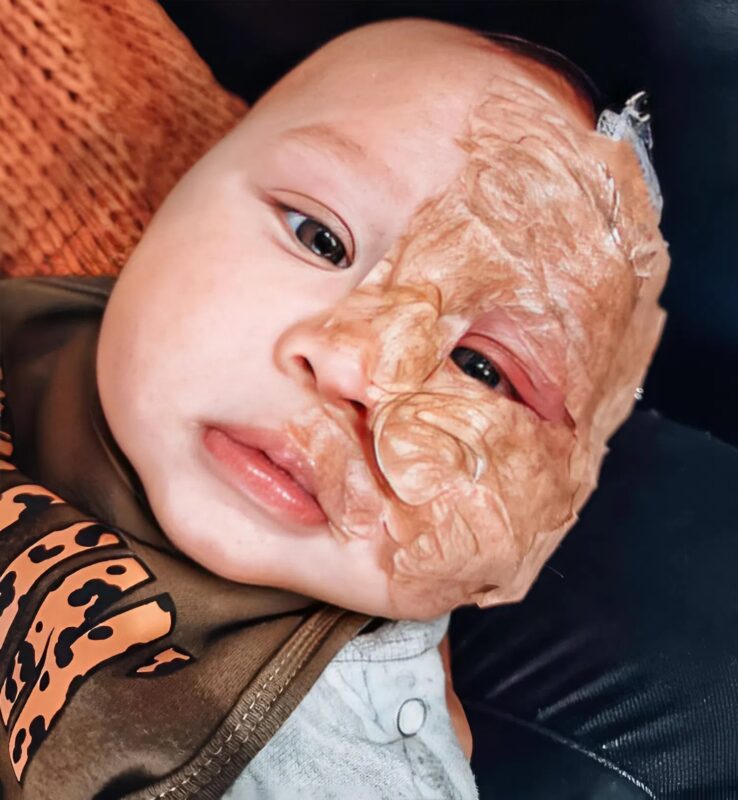
That promise led us to the option I never imagined I’d consider: laser treatment. The word itself sounded harsh, frightening, something that belonged in an operating room—not anywhere near my newborn. But every doctor repeated the same thing: *early treatment could save the health of his eye*. Kewene and I stayed awake night after night, arguing, crying, researching, praying. And finally, we said yes.
The first session was the hardest. Kingsley didn’t cry for long, but the sound was enough to fracture me. I held him afterwards, rocking him gently, whispering apologies he couldn’t understand. A small purple dot appeared where the laser had touched, and a new wave of guilt washed over me. What kind of mother lets her child go through pain when he can’t even understand why?
To cope, I began sharing pieces of our journey online—not for sympathy, but because I didn’t want any parent to feel as alone as I did. At first, people were kind. They sent prayers, encouragement, tiny digital hearts. But one morning, I opened my phone to find a flood of bitterness. Strangers calling me a monster. A narcissist. A terrible mother. Some wrote that Kingsley would hate me one day. Others accused me of caring only about his appearance.
I dropped my phone and sat on the kitchen floor, shaking. The words stung more than anything the doctors had ever told me. I felt myself breaking again, in a new and uglier way. 😢
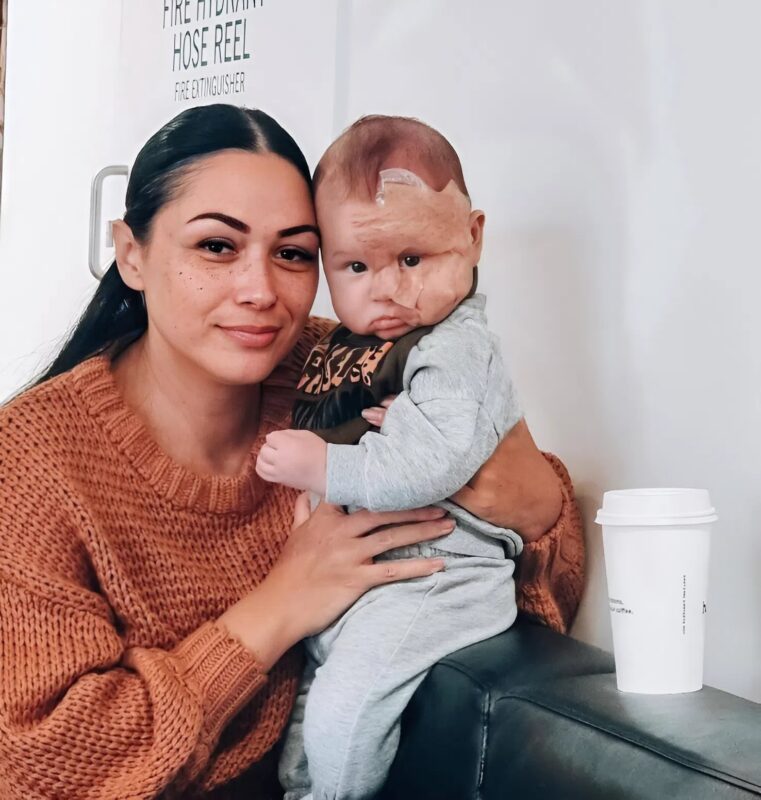
But something unexpected happened. As I scrolled through the cruelty, a new group of voices rose—voices I didn’t know but suddenly depended on. They defended me, challenged the bullies, shared their own stories of children born different. One message in particular stayed with me: *“You’re not harming him. You’re giving him a future. Don’t let ignorance be louder than love.”*
Love. That was all this had ever been about.
Months passed, and Kingsley surprised everyone with his resilience. He handled the appointments better than we did. He giggled during car rides to the hospital. He smiled at the nurses. It was almost as if he knew something we didn’t—that this difficult road would lead somewhere brighter. 🌟
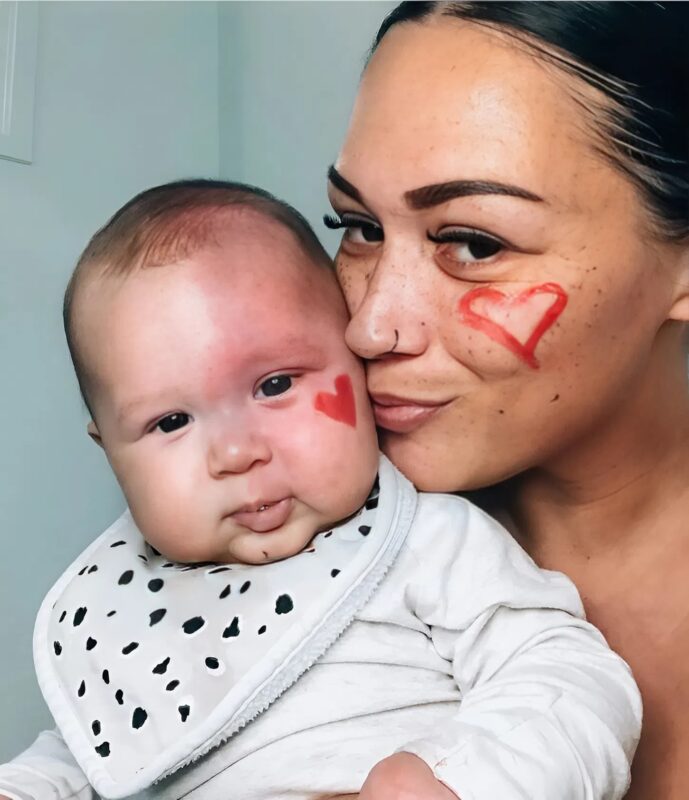
But even as his skin responded beautifully to treatment, something else began to change. Late at night, while feeding him, I started noticing a small shimmer in the corner of his marked eye—like a faint fleck of gold. At first, I blamed exhaustion. Then I saw it again, brighter this time, almost glowing.
When I mentioned it to the doctor, he looked puzzled but unconcerned. He suggested it might be a reflection, a trick of the light. But mothers know. I could feel something unusual lingering beneath the surface.
One evening, as the sun dipped low and the world turned honey-orange, I sat by the window holding Kingsley. That golden shimmer appeared again, but stronger—pulsing softly, like a tiny heartbeat of light. Kingsley blinked, looked up at me, and for the first time, it wasn’t fear I felt…it was wonder. ✨
A week later, during a routine check, our doctor paused mid-examination. His eyes widened. He leaned closer. Another specialist was called in. And another. I braced myself for the worst—bad news always travels in crowds.
But instead of dread, I heard something I had not expected at all.
“His optic nerve… it’s improving,” the specialist murmured. “This is highly unusual.”
Improving. Not stabilizing. Not holding. *Improving.*
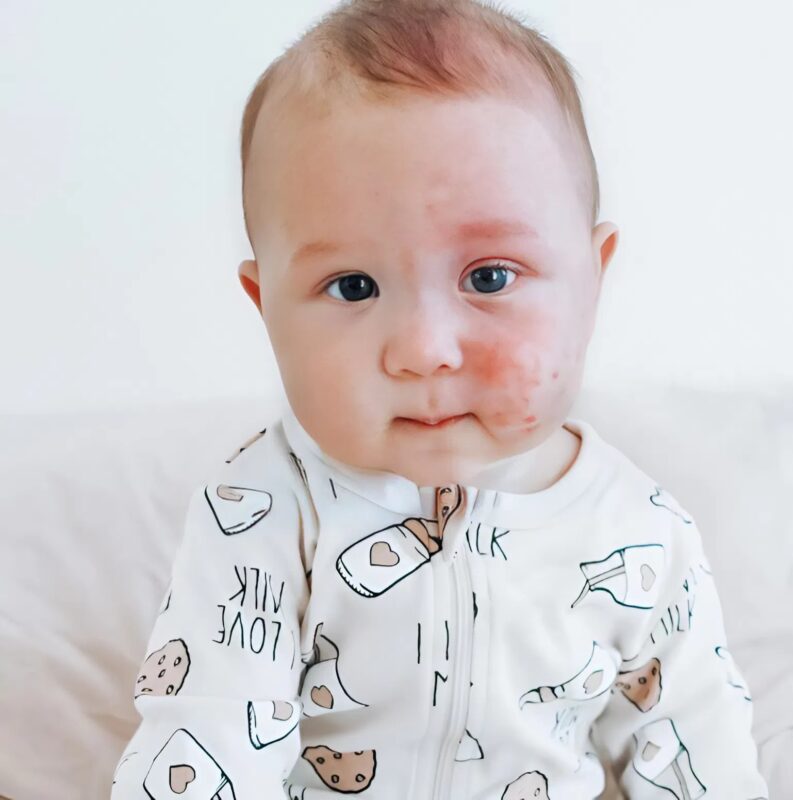
Kingsley, with his half-glowing eye and his quiet strength, was baffling every expert in the room. It was as if the very area they feared would fail him was fighting back—healing itself in ways they couldn’t explain.
That was the moment I realized something: Kingsley was not just surviving his condition. He was rewriting it. 💫
And the faint golden shimmer the doctors couldn’t explain? It grew stronger with every passing month—not dangerous, not harmful, just…beautiful. A tiny reminder that sometimes what begins as a mark of fear transforms into something extraordinary.
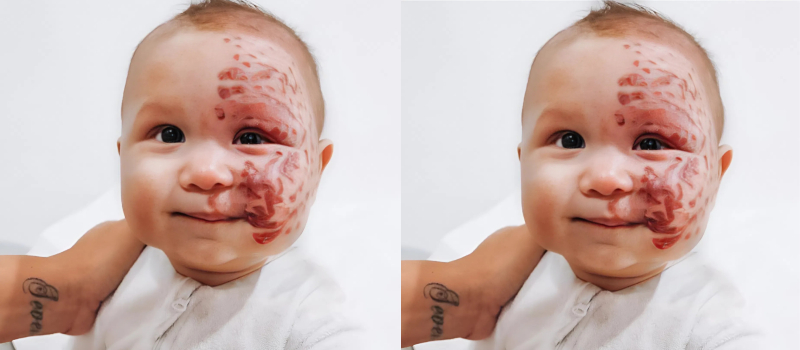
People still judge. People still talk. But when I watch my son playing, laughing, glowing in his own quiet way, I know I made the right choices. I know love guided every step.
And the most unexpected ending of all?
Kingsley’s birthmark—the one everyone thought needed to be erased—became the very thing that helped save his sight. 👁️✨