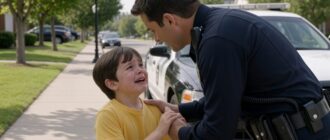
I was driving home when I suddenly heard a loud impact. A crack appeared in my car’s side window. I slammed on the brakes and spotted a boy of about six standing on the sidewalk, holding a stone. Furious, I got out and approached him. “Do you have any idea what you’ve done?” I shouted. The little boy began trembling, and tears rolled down his cheeks. “I’m sorry… I asked everyone to stop, but nobody would,” he whispered. Then he pointed across the street. A few meters away, an elderly woman sat motionless on a bench. A grocery bag had fallen beside her feet. “My grandma won’t wake up,” the child sobbed. I rushed to the woman and immediately called an ambulance. But when I discovered her name, I realized that my presence on that street was connected to something extraordinary. Her name brought back a childhood memory I had almost completely forgotten.
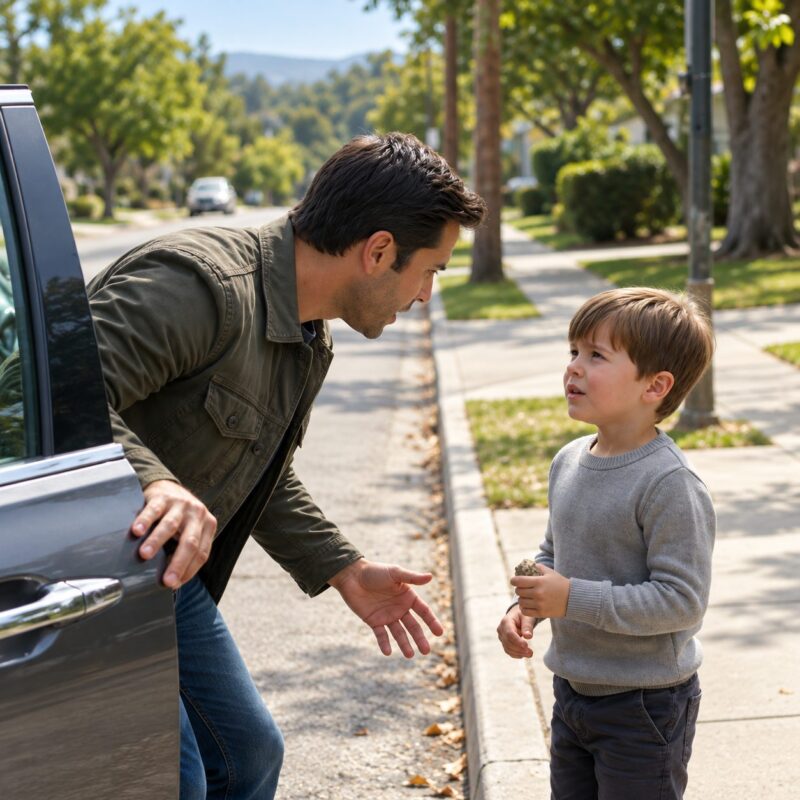
That day, I had left work earlier than usual. I was thirty-five years old, worked for a construction company, and had barely found time to rest over the past few weeks. My head was aching, my phone kept ringing, and all I wanted was to get home, drink a hot cup of coffee, and spend a few hours without speaking to anyone.
Instead of taking the main road, I decided to drive through the quiet streets on the outskirts of town. There was less traffic there, and I thought I would get home faster.
But that decision changed my entire day.
I was slowly driving past a row of small houses when a sharp impact suddenly struck the side of my car.
For a moment, I thought something had fallen from a roof.
Then I noticed the crack in my side window.
I immediately hit the brakes.
“What on earth was that?”
I glanced into my side mirror and saw a little boy.
He was standing on the sidewalk, holding a stone. Several other small stones lay near his feet.
My first thought was that the child had deliberately damaged my car.
Anger surged through me.
I got out and marched toward him.
“Hey! What do you think you’re doing? Do you have any idea what could have happened?”
The boy flinched.
He looked about six years old. He had short brown hair, a thin face, and worn-out sneakers. The sleeves of his light-colored sweater were dirty.
He slowly lowered the stone in his hand.
“I’m sorry…”
“Sorry? You nearly smashed my car window!”
That was when I noticed his eyes.
They were filled with tears.
His little lips were trembling.
“I didn’t mean to…”
“Then why did you do it?”
He tried to speak, but his voice broke.
Only after several seconds did he manage to whisper:
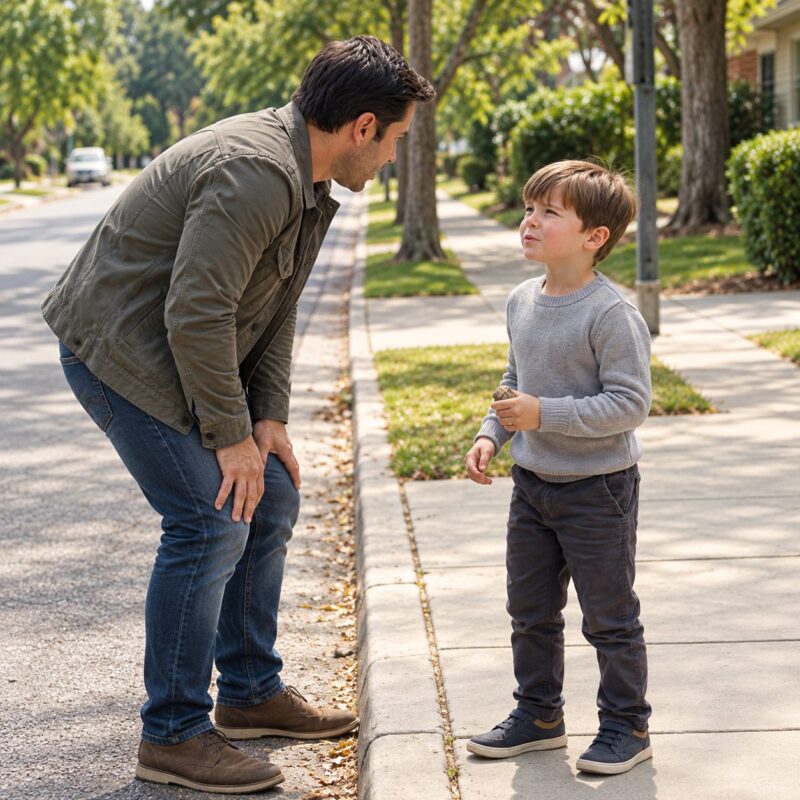
“Because nobody would stop.”
My anger briefly gave way to confusion.
“What are you talking about?”
The boy raised his little hand and pointed across the street.
“My grandma… She won’t wake up.”
I looked in the direction he was pointing.
A few meters away, on a bench beneath a tree, sat an elderly woman. Her head was tilted to one side, and her hands rested motionlessly on her knees.
A grocery bag had fallen beneath the bench. Apples and several other items were scattered across the sidewalk.
I didn’t ask another question.
I ran toward her.
“Ma’am, can you hear me?”
There was no response.
Her face was pale, and her eyes were closed.
I checked whether she responded and whether she was breathing. She was breathing, but she did not react to my voice.
I immediately called an ambulance.
While I was giving the dispatcher our location and describing the woman’s condition, the boy came running toward us.
He stopped in front of the bench and grabbed his grandmother’s coat with both hands.
“Grandma, I brought someone! Please wake up!”
Hearing those words made my throat tighten.
The dispatcher confirmed that help had been sent and gave me instructions on how to monitor the woman’s condition until the paramedics arrived.
I knelt beside the boy.
“What’s your name?”
“Daniel.”
“Daniel, I’m Adam. The doctors are already on their way.”
He looked at me as though all his hope depended on my answer.
“Is my grandma going to get better?”
“We’re here with her now. The doctors will do everything they can to help.”
He nodded, but he continued crying.
For several seconds, we sat in silence.
Then the boy suddenly said:
“I tried stopping other cars too.”
“How?”
“I waved at them. I shouted. One man told me to go home.”
His voice began trembling again.
“Then another car came. I ran toward it, but it drove away too.”
I looked toward the road.
Now everything made sense.
This little boy had seen his grandmother become unresponsive and had desperately tried to find help. When nobody stopped, he had thought of something that might force a driver to pay attention.
“Why did you pick up a stone, Daniel?”
He lowered his head.
“Because if the car stopped, I could ask for help.”
It felt as though a curtain had suddenly been lifted from my eyes.
Only minutes earlier, I had been shouting at him, thinking about my cracked window.
Now I understood that throwing that stone had been his desperate attempt to make someone stop.
“I’m sorry I got angry,” I said.
The boy looked at me in surprise.
“Do you forgive me too?”
“Yes. I know you were scared. But throwing stones at cars is dangerous. If you ever need help again, you should call for it from somewhere safe.”
He nodded silently.
“I just didn’t want Grandma to be alone.”
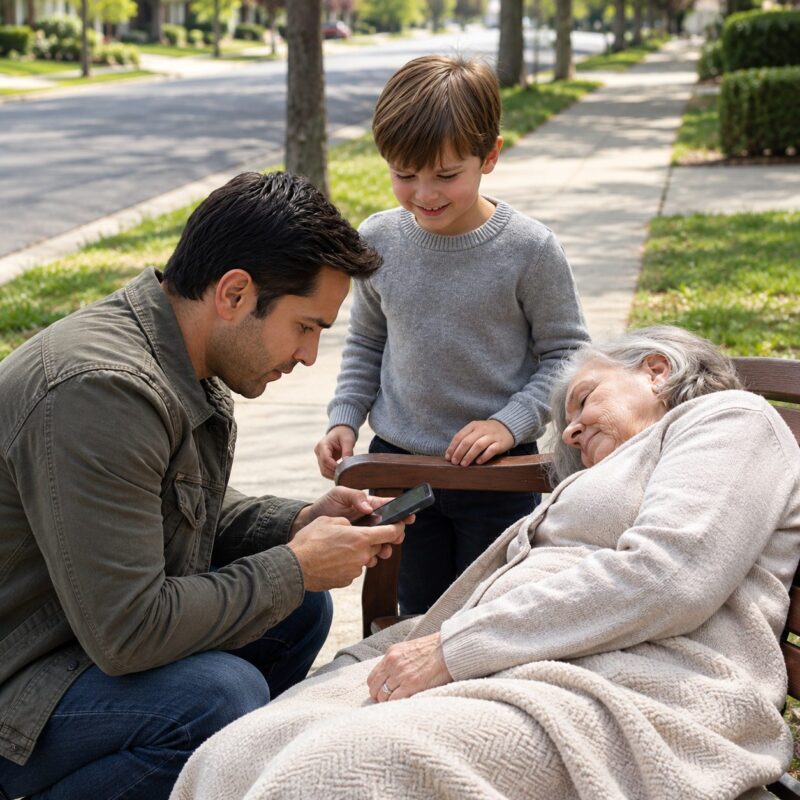
I still remember those words.
About seven minutes passed.
Daniel sat beside me. His tiny fingers clung to the sleeve of my jacket. Every time he heard a vehicle in the distance, he lifted his head, hoping it was the ambulance.
Finally, we heard the siren.
The paramedics arrived, and I quickly explained what had happened.
They examined the woman, provided the necessary medical care, and began preparing to take her to the hospital.
Daniel stood anxiously near the bench.
“Can I go with her?”
One of the paramedics knelt in front of him.
“We’re taking your grandma to the hospital so the doctors can help her. But right now, we need to find another grown-up from your family.”
The boy looked at me in confusion.
I asked whether he had any other relatives nearby.
“My mommy is working. Grandma picked me up after school. We went to the store.”
“Do you know your mommy’s phone number?”
He shook his head.
But then he said:
“Grandma has a phone in her bag.”
I picked up the fallen grocery bag and found the woman’s phone.
An emergency contact was listed on the screen under the name Emily.
I called.
I explained the situation to the young woman who answered. She introduced herself as Daniel’s mother and promised to come straight to the hospital.
Before ending the call, she asked:
“Excuse me, could you tell me what condition you found my mother in?”
I told her everything I knew.
Then she added:
“Her name is Margaret Wilson. She’s seventy-five years old.”
The moment I heard that name, I froze.
Margaret Wilson.
I repeated it silently.
I couldn’t believe it.
I hadn’t heard that name in years, but it was so familiar that I suddenly felt transported back to my childhood.
When I was ten, we lived in an old neighborhood across town. My father left for work early every morning, my mother was often ill, and I spent hours at the library after school.
An elderly librarian worked there.
Mrs. Wilson.
She always noticed when I was sad.
Once, on a freezing winter afternoon, I arrived at the library wearing a thin jacket and shoes that were completely soaked.
Mrs. Wilson gave me hot tea, found me a pair of dry socks, and said:
“Adam, whenever you need help, never be ashamed to ask for it.”
I had carried those words with me.
But over the years, I had forgotten the woman’s name and face.
And now, after all this time, the unresponsive woman sitting on that bench might be the very same person.
“Daniel,” I asked quietly, “did your grandma used to work in a library?”
The boy looked surprised.
“Yes! She has lots of books.”
My heart began beating faster.
When the paramedics helped the woman into the ambulance, I asked which hospital they were taking her to.
I passed the address along to Daniel’s mother.
Then I stayed with the boy until a trusted adult from his family arrived. His aunt soon came and took him into her care.
I also headed to the hospital.
Daniel’s mother, Emily, was already there. She looked distressed, but when she saw her son arriving with his aunt, she hugged him tightly.
“Daniel, sweetheart, what happened?”
The boy began explaining everything in his own words.
“Grandma sat down. Then she closed her eyes. I called people, but they wouldn’t stop.”
Emily began crying.
Daniel continued:
“Then I threw a stone at a car.”
She looked at me in shock.
I showed her a photograph of my damaged side window.
“Please don’t worry about that right now. What matters is your mother’s condition.”
Emily remained silent for a moment, then said:
“She picks Daniel up from school every day. Today was the first time they decided to stop at the store.”
About an hour later, a doctor came out.
Margaret’s condition had stabilized. She had regained consciousness, although she still needed further examinations.
Emily sank into a chair with relief.
Daniel wrapped his arms around his mother.
“Is Grandma going to wake up now?”
“Yes, sweetheart. She’s already awake.”
For the first time, a smile appeared on the little boy’s face.
When we were allowed to visit Margaret, I approached her hospital bed.
She looked at me for a long moment, then raised her eyebrows slightly.
“Do we know each other?”
I smiled.
“Mrs. Wilson, do you remember a boy who used to spend every afternoon after school in your library?”
She studied my face carefully.
“Adam…?”
I nodded.
Margaret’s eyes filled with tears.
“Is that really you? Look how you’ve grown!”
I sat down beside her bed.
“You once taught me that there was nothing shameful about asking for help.”
She smiled.
“And what happened after that?”
I looked toward Daniel, who was standing near the door.
“Today, your grandson asked for help at exactly the right moment.”
The little boy came closer.
Margaret took his hand.
“My clever boy…”
Daniel said tearfully:
“Grandma, I did something bad. I hit a car with a stone.”
The woman looked at him in surprise.
I calmly explained everything.
Margaret remained silent for a long moment.
Then she held her grandson’s hands between her palms.
“Daniel, I’m so grateful that you found help. But promise me you’ll never throw stones at cars again.”
“I promise.”
He hugged his grandmother.
I turned toward the window so nobody would see the tears gathering in my eyes.
A few days later, Margaret was discharged from the hospital.
I visited them at home.
Daniel opened the door and immediately asked:
“Did you fix your window?”
I laughed.
“Yes, little buddy.”
He ran into another room and returned holding a small envelope.
Inside was a drawing made with colored pencils. It showed a car, a man, a little boy, and an elderly woman standing together.
At the bottom, someone had written:
“Thank you for stopping.”
I stared at those words for a long time.
Then Margaret approached and said:
“You know, Adam, sometimes life returns the kindness we gave to others many years ago.”
That afternoon, I drove home along the same street.
Through my newly repaired window, I looked at the bench where I had first seen Margaret.
And I thought about how easily anger had blinded me.

If I had thought only about my damaged window, perhaps I would never have listened to the boy’s words.
But behind little Daniel’s desperate action was an enormous amount of love.
Since that day, I have never been quick to judge another person’s actions without understanding the reason behind them. Sometimes, behind the most unexpected behavior, there is a tiny heart simply trying to save the person it loves most.